
The Clerk of the Superior Court in Sacramento County
Sacramento Superior Court runs its own clerk function. Filings, certified copies, exemplifications, calendaring, and fee collection all happen through the court clerk's office under the Superior Court of California, County of Sacramento. The court is at saccourt.ca.gov. Operations are spread across courthouses based on division: civil, criminal, family, probate, juvenile, traffic, and small claims. The court is led by an elected presiding judge and run day to day by a court executive officer rather than a separately elected court clerk.
People searching for "Sacramento County court clerk" often mean two different offices. One is the court clerk function inside Sacramento Superior Court; that is what this page covers. The other is the Sacramento County Clerk/Recorder, a separate elected county office that records deeds and issues marriage licenses. The Clerk/Recorder is Florence Evans, at ccr.saccounty.gov. For marriage and recorded documents, see the marriage and divorce page and the public records page.
Sacramento Superior Court Clerk's Office
Gordon D. Schaber Sacramento County Courthouse
720 9th Street
Sacramento, CA 95814
California Has No Separate District Clerk
California does not use the Texas-style district clerk split. There is no separately elected district clerk for state-court cases. The court runs its own clerk function in-house. Anyone who lands on this page after reading about a district clerk in another state should know that Sacramento Superior Court does not work that way. The federal U.S. District Court for the Eastern District of California has its own clerk, but that is a different court system at caed.uscourts.gov and is not the same as Sacramento Superior Court.
Sacramento Superior Court Clerk Functions
The court clerk's office is the operational backbone of the Superior Court. Every filing crosses a clerk's desk. Every certified copy needs a clerk's seal. The clerk does not decide cases. The clerk processes paperwork, builds the docket, and supports the judicial officers who do.
- Accept and process new filings in civil, criminal, family, probate, juvenile, traffic, and small claims cases.
- Maintain the official case file and the register of actions for each case.
- Issue certified copies of court orders, judgments, and other case documents.
- Issue exemplified copies for use in courts outside California.
- Calendar hearings and post court schedules.
- Collect filing fees, copy fees, and other court fees set by statute and the local fee schedule.
- Process e-filings submitted through approved electronic filing service providers.
How to Request a Certified Copy of a Court Record
A certified copy carries the court seal and the clerk's signature. Banks, employers, immigration officers, and other courts often refuse plain prints. Use a certified copy when proof of the document is the point of the request.
- Find the case in Public Case Access. Note the case number, the title, the filing date, and the exact document you need.
- Pick up or download the court's records request form from the court website. Some divisions accept email requests; others require paper.
- Pick the copy type. Plain copy, certified copy, or exemplified copy each carry a different fee.
- Submit the request to the right division's records counter, in person or by mail. Include the case information, the document description, the number of copies, and contact information.
- Pay the fee from the current court fee schedule. The clerk cannot release the certified copy without payment, unless a fee waiver is on file for the case.
- Wait for processing. Counter pickup is fastest. Mail requests can take longer. Archive retrieval for older files takes more time still.
- Inspect the copy when you receive it. The seal must be visible. The signature must be present. A missing seal makes the copy useless for legal purposes.
Electronic Filing Through an EFSP
Sacramento Superior Court uses electronic filing for many case types. The court does not run its own filing portal directly. Filings go through an electronic filing service provider, or EFSP. An EFSP is a third-party vendor approved by the court. The vendor transmits the documents and the payment to the court and returns the filing status to the filer. Lists of approved EFSPs sit on the court's e-filing page.
EFSPs may charge transaction fees on top of the court filing fee. The court explains that those EFSP fees are waived for parties with an active fee waiver, for government agencies, and for court-appointed counsel. A regular paying filer should expect both the court fee and any EFSP convenience charge. The filer is responsible for sending complete, properly named documents. The EFSP sends the filing on, but missing documents or wrong captions can lead to rejection.
E-filing has three distinct events: submission to the EFSP, transmission to the court, and clerk acceptance. A submission that reaches the court is not a filing until the clerk accepts it. The clerk can reject an envelope for missing items, wrong format, wrong case type, or other intake problems. A rejection is not a ruling on the merits. The filer fixes the problem and resubmits.
Civil Document Processing Dates
The court posts processing dates for civil filings. The civil division updates the dates every business Friday by 5 p.m. The chart shows the date through which each category of filing has been processed. Common categories include new civil cases, requests for dismissal, writs of execution and abstracts, answers and cross-complaints, and requests for entry of default or clerk judgment. The dates matter because a filing presented to the court may not appear on the docket until the clerk catches up. A reader who searches Public Case Access and finds nothing should check the processing dates before assuming the filing was rejected.
The same gap shows up in other divisions in different forms. Criminal filings, probate filings, and family law filings each have their own intake flow. A user who needs same-day proof of filing should ask for a conformed copy at the counter or check the EFSP confirmation. Online dockets follow later.
Lead-in image. The civil division landing page at saccourt.ca.gov/civil hosts the civil processing-date list along with civil filing information.
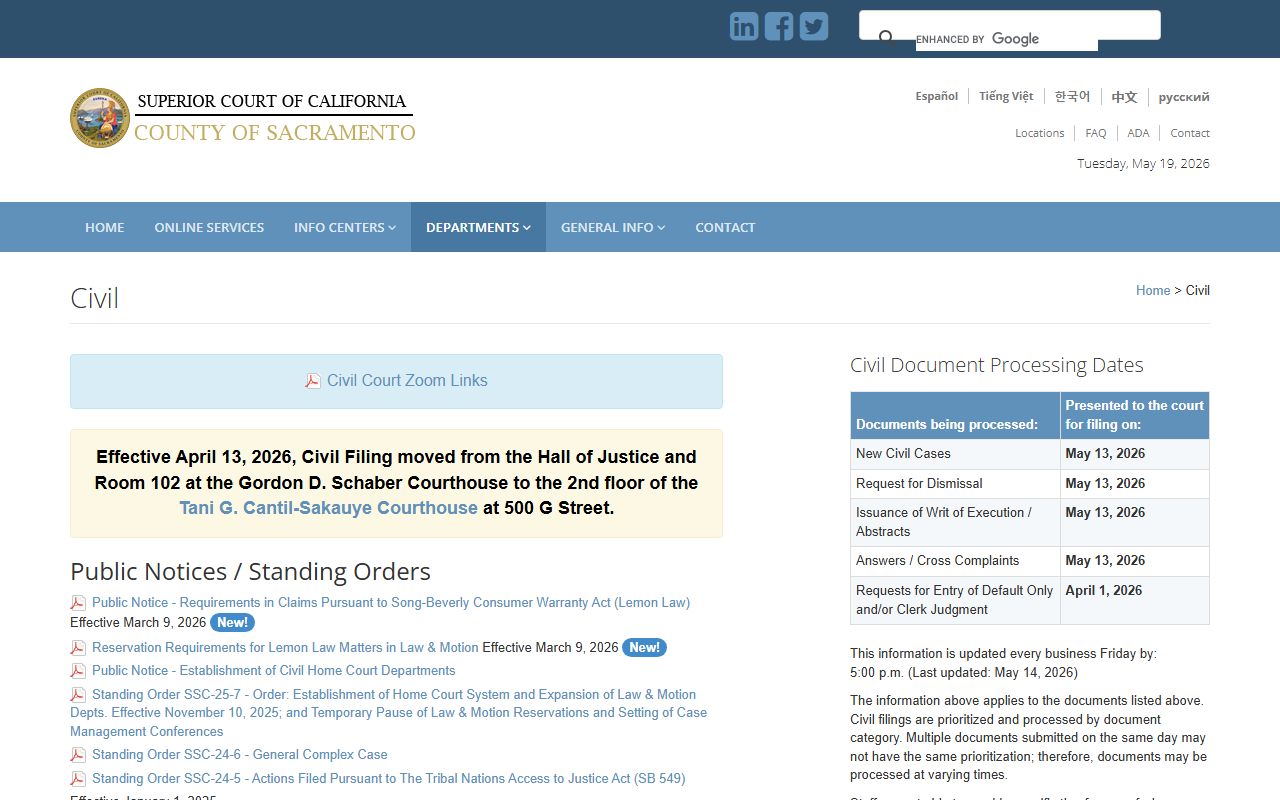
Check the latest civil processing date before assuming a filing was lost.
Sacramento Superior Court Clerk Fees
Court fees are set by statute and by the local fee schedule. The current chart lives at saccourt.ca.gov/fees. Fees change. Use the official page before you send payment. Fee waivers are available to qualifying low-income filers under Judicial Council form FW-001.
| Item | Source |
|---|---|
| Civil unlimited filing | Sacramento Superior Court fee page |
| Civil limited filing | Sacramento Superior Court fee page |
| Family law petition filing | Sacramento Superior Court fee page |
| Probate petition filing | Sacramento Superior Court fee page |
| Small claims filing | Sacramento Superior Court fee page |
| Plain copy per page | Sacramento Superior Court fee page |
| Certified copy per document | Sacramento Superior Court fee page |
| Exemplified copy | Sacramento Superior Court fee page |
| Records search fee | Sacramento Superior Court fee page |
Forms, Local and Statewide
Most California court forms come from the statewide Judicial Council library at courts.ca.gov/forms.htm. Sacramento Superior Court adds local forms on top of that for county-specific filings. The local forms page is saccourt.ca.gov/forms. A user who files in Sacramento should check both lists. A filing that uses the wrong local form, or skips a required local form, can be rejected at intake.
Lead-in image. The Sacramento forms page at saccourt.ca.gov/forms lists local forms and links to the statewide Judicial Council library.
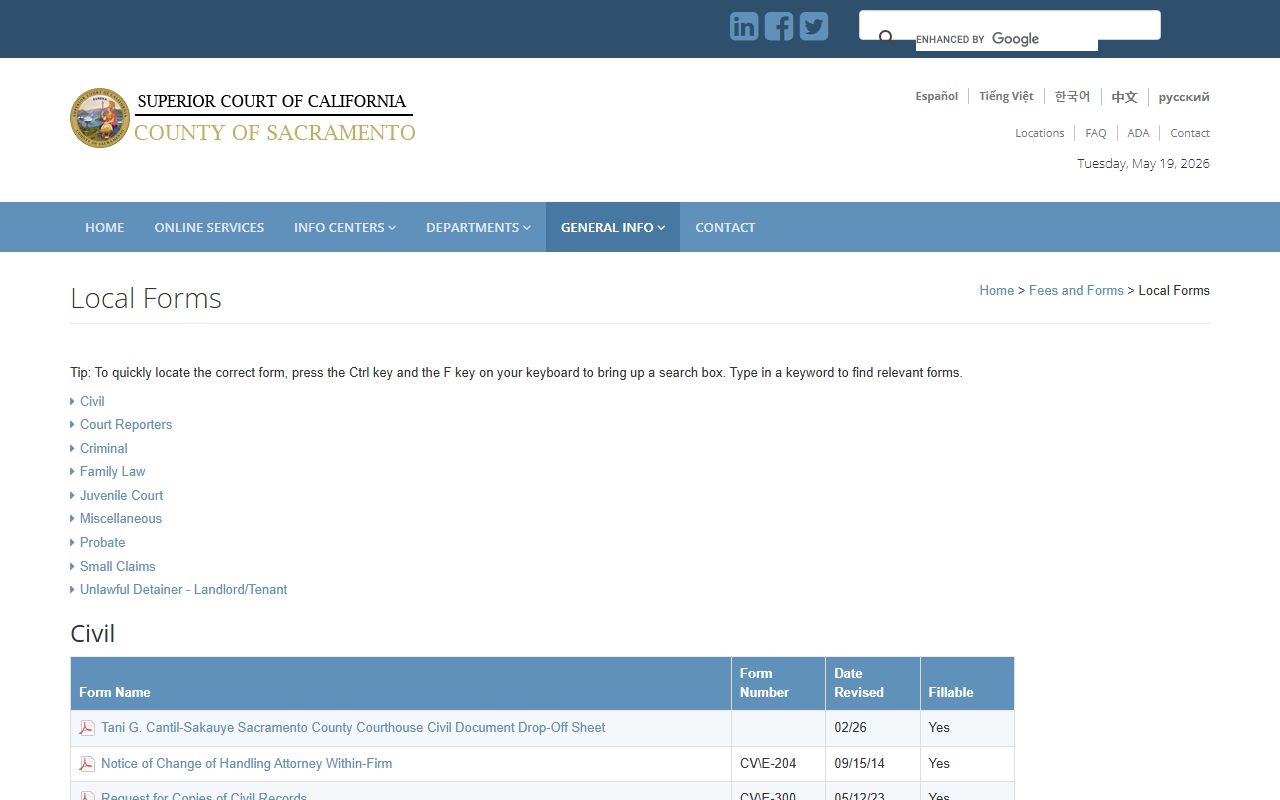
Use the statewide form for the underlying request and check the local form list for any Sacramento add-ons.
Contact and Hours
The main courthouse for Sacramento Superior Court is downtown at the Gordon D. Schaber Sacramento County Courthouse, 720 9th Street, Sacramento, CA 95814. Family law sits at the William R. Ridgeway Family Relations Courthouse, 3341 Power Inn Road, Sacramento, CA 95826. Traffic and small claims often run out of the Carol Miller Justice Center, 301 Bicentennial Circle, Sacramento, CA 95826. The Juvenile Courthouse is at 9605 Kiefer Boulevard, Sacramento, CA 95827. Each courthouse has its own clerk counter. Current hours are posted on the court locations page.
The court runs an interpreter program for in-court matters and an ADA accommodation process for hearings. Both are coordinated through the court website rather than the local clerk counter. A reader who needs language access or a disability accommodation should use those court pages before the hearing date.
Difference Between the Court Clerk and the Sacramento County Clerk/Recorder
The two offices share part of a name and do not share work. The Sacramento Superior Court Clerk's Office keeps court case files. The Sacramento County Clerk/Recorder keeps recorded deeds, marriage licenses, and vital records. A court clerk cannot record a deed. A recorder cannot file a lawsuit. A user who asks the court for a marriage license will be sent to the Clerk/Recorder. A user who asks the Clerk/Recorder for a divorce judgment will be sent to the court. For marriage and divorce, see Sacramento marriage and divorce records. For the open-records framework, see Sacramento County public records.
Common Reasons a Filing is Rejected
A rejection is not a ruling. The clerk reviews each filing for basic intake compliance and bounces filings that miss the mark. Knowing the most common rejection reasons saves time.
- Wrong case caption, including a typo or wrong court name.
- Missing required form, such as the case cover sheet or a local form.
- Missing signature, missing date, or missing verification.
- Wrong fee amount or missing fee waiver request.
- Wrong document title in the EFSP envelope, which routes the filing to the wrong queue.
- Late filing without a request for relief.
- Proof of service that does not match the document being served.
Records Request Form-Field Inventory
The records request form is short but exact. Missing fields slow the request. The chart below shows the fields a records request usually asks for.
| Field | Required | Notes |
|---|---|---|
| Case Number | Yes | Use the exact format. Old cases may have a different format. |
| Case Title | Yes | Full title as filed, such as Smith v. Jones or Estate of Lee. |
| Document Title and Date | Yes | Identify the exact filing. A vague request slows the search. |
| Copy Type | Yes | Plain, certified, or exemplified. |
| Number of Copies | Yes | Each certified copy carries its own fee. |
| Requester Name and Contact | Yes | Used for pickup or mail return. |
| Payment | Yes | Cash, check, money order, or card per court policy. |
| Fee Waiver | Conditional | Provide if an active fee waiver applies to the case. |