
Active Warrants in Sacramento County
Sacramento Superior Court issues most warrants tied to state criminal cases in the county. A judge signs the warrant after probable cause or a hearing event triggers it. The Sacramento County Sheriff and city police agencies execute many of those warrants. The Sheriff's office, led by Sheriff Jim Cooper, also tracks warrants and holds in jail booking systems. Some warrants do not appear in any public search before arrest. Sealed warrants, sealed indictments, and search warrants in active investigations are usually not posted to the public until they have been executed.
Sacramento County does not publish a full public master list of every active warrant. Some counties post a partial bench-warrant or wanted-persons list; Sacramento County's official sources direct users to verify through the Superior Court case access portal, the Sheriff's inmate information system, and, where needed, direct contact with the court or law enforcement.
Sacramento Superior Court case dockets can show warrant entries. A bench warrant entry can read "bench warrant issued," "warrant recalled," "warrant held," "FTA," or "bail forfeited." A jail inmate profile can show a hold or warrant number. A docket entry is the closest reliable public confirmation that a warrant exists for a known case.
Types of Sacramento County Warrants
Warrant types matter because each has its own trigger, its own visibility rules, and its own path to resolution. A bench warrant for a missed court date is different from a search warrant for a property. A probation warrant is different from a fugitive hold from another state.
- Arrest warrant authorizes law enforcement to arrest a named person, usually based on probable cause or the charging process.
- Bench warrant is issued by a judge, most often after a failure to appear, failure to obey a court order, or contempt.
- Search warrant authorizes law enforcement to search a place, person, or device, and is often sealed during an active investigation.
- Probation or parole warrant is based on a supervision violation and may carry a no-bail status.
- Body attachment or civil warrant is a court order compelling appearance in certain civil, family, or support contexts.
- Fugitive warrant or hold is based on another jurisdiction's warrant and may keep a person in custody pending transfer.
How to Search Sacramento County Warrants
The first official check is the Superior Court case file. If a warrant has issued in an open criminal case, the docket may show it. The second check is the Sheriff's inmate information system, which can show holds and warrants tied to a current booking.
The court's public criminal portal is the first official place to verify a warrant tied to a known case. See the Sacramento criminal case access page.
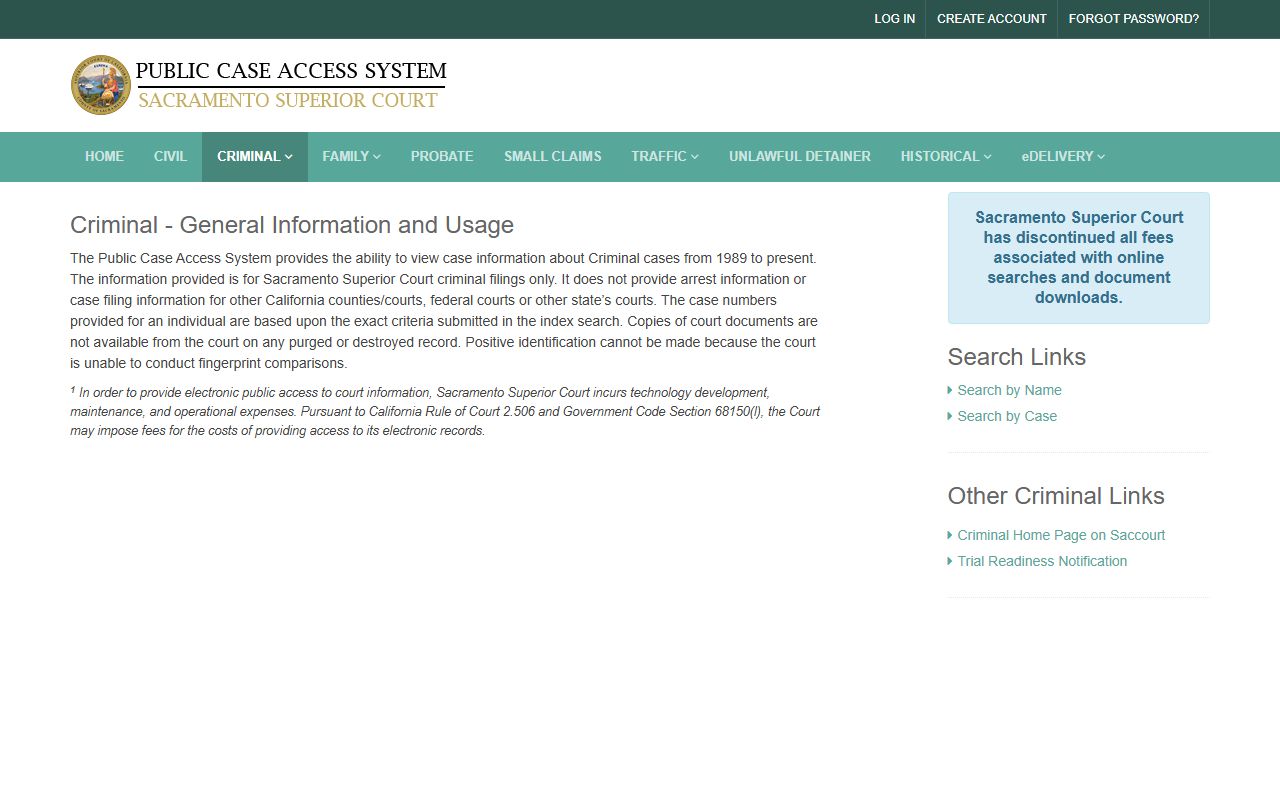
The criminal case access portal lets a user search by case number, defendant name, and date of birth. If a docket shows a bench warrant issued and no recall, the warrant may still be active.
- Open Public Case Access Criminal and search by the defendant name or case number.
- Look on the docket for entries that read "bench warrant issued," "FTA," "bail forfeited," or "warrant held."
- Look for a later entry that reads "warrant recalled" or "warrant quashed." If you do not see one, the warrant may still be active.
- If the person is currently booked, check the Sheriff inmate search by name for hold or warrant data.
- If the warrant is from another county or state, contact that issuing court or agency, not Sacramento.
- For confirmation, contact the court clerk through the Clerk of the Superior Court page or speak with a criminal defense lawyer.
Sacramento County Warrant Search Fields
The Superior Court criminal portal and the Sheriff inmate search expose a small set of common fields. A user does not need every field. A clean case number is best. A last name plus date of birth is the next best combination. The fields below describe what to expect.
| Field | Type | Required | Notes |
|---|---|---|---|
| Case Number | Text | No | Best single field. Format depends on filing year and division. |
| Last Name | Text | Conditional | Exact spelling helps. Try alternates for hyphenated or changed names. |
| First Name | Text | No | Narrows results for common surnames. |
| Date of Birth | Date | Often requested | Cuts false matches on common names; treat as privacy-sensitive. |
| Booking / XREF Number | Text | No | On the Sheriff inmate search, helps locate a current custody record. |
| Search | Button | n/a | Runs the query. |
What a Sacramento County Warrant Record Shows
Where warrant data is visible, it tends to include a defined set of fields. Some are on the court docket. Some are on the jail inmate profile. Some are visible only on internal law enforcement systems. The fields below describe what may appear when a warrant is exposed in a public record.
- Name of the person named in the warrant.
- Case number tied to the criminal or civil case.
- Warrant number assigned by the court or law enforcement system.
- Issuing court, often a department of Sacramento Superior Court.
- Issue date the judge signed the warrant.
- Charge or violation, with code section where shown.
- Bail or bond amount, including no-bail status if set.
- Warrant type, such as arrest, bench, probation, or fugitive.
- Status: active, recalled, served, quashed.
- Next court date after service or surrender.
- Hold agency on the inmate record where applicable.
Booking photos are not promised on a warrant page. California law restricts release of some booking photos. Sacramento Sheriff press releases in 2025 noted that booking photos were ineligible or prohibited for public release in particular cases, including a September 22, 2025 release involving non-violent charges. A warrant record concerns legal authority to arrest. The booking photo is a separate jail and law-enforcement issue.
Bench Warrant Triggers in Sacramento County
Bench warrants are common in Sacramento County and often surprise people who did not know one had issued. A bench warrant can issue at the end of a courtroom day after a failure to appear, or it can issue weeks later when the court reviews a missed deadline. The Superior Court's criminal division handles many of these.
- Failure to appear for arraignment, trial, sentencing, review, or a payment hearing.
- Failure to obey probation terms, such as drug testing, treatment, or check-ins.
- Failure to complete community service, classes, or other ordered programs.
- Failure to pay or address fines, fees, or restitution where nonappearance is involved.
- Contempt of court, including disobedience of a court order.
- Violation of a restraining or protective order.
- Failure to comply with a subpoena or court order in some civil or family matters.
Note: A bench warrant can sit in the system for years, so the safest move is to confirm status before any contact with the courthouse or the jail.
How to Resolve a Sacramento County Warrant
Resolving a warrant is a sequence, not a single act. The steps below are general. The right move depends on the warrant type, the underlying charge, the bail status, and the person's circumstances.
- Verify the warrant through official sources: Public Case Access, the Sheriff inmate page, or direct court contact.
- Identify the issuing court and case number from the docket.
- Identify the warrant type. A bench warrant is often easier to address by court appearance than a serious felony arrest warrant.
- Talk to a criminal defense lawyer before walking into the courthouse or jail. Outcome can include immediate arrest.
- For a bench warrant, ask the court or lawyer about calendar placement, warrant recall, bail, and proof of compliance.
- For a felony arrest warrant, plan surrender with counsel. Booking and release follow jail and court procedures.
- After the hearing, confirm the docket shows the warrant recalled, quashed, or served. Updates can lag.
- If the warrant is from another county or state, follow that jurisdiction's process. Sacramento court cannot recall another county's warrant.
Important: A person who may have a Sacramento County criminal warrant should usually speak with a defense lawyer before contacting the jail or the court, because the outcome of voluntary contact can include immediate arrest.
Why Third-Party Warrant Sites Are Unreliable
Many commercial websites advertise "Sacramento County warrant" lookups. Those sites are not the court and not the Sheriff. They often scrape stale public records, mix counties, or sell access to data that is already free on official sites. They sometimes show a warrant that has been recalled, miss a warrant that just issued, or attach a wrong person to a record because of a name match.
Important: A legal decision about a warrant, surrender, bail, or court appearance should never rest on a third-party warrant database. Use the Superior Court docket, the Sheriff inmate system, the issuing court, or a licensed California attorney as the source of truth.
The Sheriff's main site, at sacsheriff.com, links the official inmate, contact, and public-safety resources. The Superior Court's main site, at saccourt.ca.gov, links the official case-access portals. Both are free.
Restricted Sacramento County Warrant Records
Several warrant categories are not public. Sealed search warrants in active investigations are not released until after execution and any court-ordered unsealing. Grand jury indictment warrants are sealed until arrest. Juvenile warrants are tied to confidential juvenile case files under Welfare and Institutions Code section 827. Federal warrants from the U.S. District Court for the Eastern District of California are a separate system; those are processed by the U.S. Marshals Service and are not on the Sacramento Superior Court portal.
Dismissed and dismissed-and-sealed cases may also have warrant references that no longer appear on a public docket. A clean public docket is not a guarantee that no warrant ever issued. The court clerk is the safest authority on whether a recall has been entered.