
The Sacramento County Superior Court System
The Superior Court of California, County of Sacramento, is the trial court of general jurisdiction for the county. One court hears all state-law matters that arise inside Sacramento County lines. Felony, misdemeanor, infraction, civil, family, probate, juvenile, traffic, and small claims cases all sit under the same court. The court runs out of several courthouses, but it is still one Superior Court with case-type divisions rather than separate trial courts. The main online entry point is saccourt.ca.gov, and the public records search lives at the Public Case Access portal.
The court's website organizes services by division. Civil filings have their own page, criminal calendars have theirs, and family, probate, juvenile, traffic, small claims, jury, self-help, interpreters, and accessibility each have a dedicated landing page. That split matters for a records search. A divorce case lives in family. An estate sits in probate. A red-light ticket appears under traffic. A speeder hit with a misdemeanor reckless driving charge lands in criminal. The case-type tab on the public portal mirrors how the court routes filings.
Why California Has Superior Courts and Not State District Courts
California is a unified trial court state. Voters approved trial court unification in the late 1990s, and by 1998 the state had merged the old municipal courts into each county's Superior Court. There is no Sacramento County District Court at the state level. There is no separate justice court or county court either. Many users from other states still type "Sacramento County District Court" out of habit, because Texas, Colorado, Alabama, and other states use that name for their main trial court. In California, that search points at the Superior Court.
The phrase "district court" still has a real meaning in Sacramento, but only in the federal context. The U.S. District Court for the Eastern District of California is a federal trial court. Federal cases use a separate filing system, separate judges, separate case numbers, and separate online access through PACER. Treating a state Superior Court matter as a federal case (or the reverse) leads to wasted trips and missed deadlines. Always confirm whether the case is state or federal before searching.
One court, many courthouses. That is the simple model to keep in mind. The court itself is the Superior Court of California, County of Sacramento. The buildings, departments, and divisions are how the court parcels out the workload.
Sacramento Superior Court Divisions
Sacramento Superior Court splits its work into subject-matter divisions. Each division has its own filing rules, calendars, and primary courthouse. A reader who finds the right division has done most of the work of a records search.
An overview of the Superior Court traffic and case-type pages lives at saccourt.ca.gov/traffic, and a snapshot of the traffic division landing page is shown below.
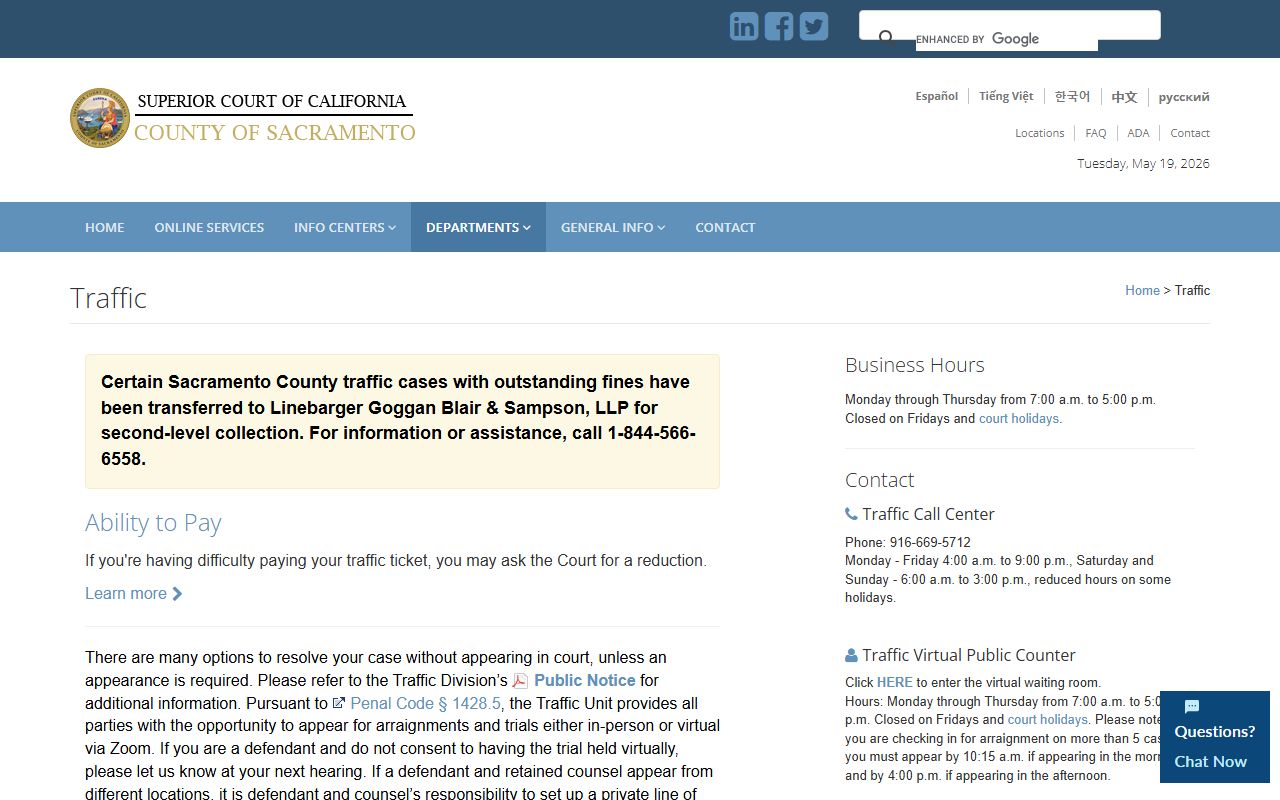
The traffic page lists pay, plead, and trial options and is one of eight major division landing pages on the court website.
| Division | Primary Location | Role |
|---|---|---|
| Criminal | Gordon D. Schaber Courthouse, 720 9th Street | Felonies, misdemeanors, arraignments, preliminary hearings, trials, sentencing, postconviction motions. |
| Civil | Gordon D. Schaber Courthouse and Hall of Justice | Unlimited civil, limited civil, unlawful detainer, civil harassment, law and motion, civil trials. |
| Family Law | William R. Ridgeway Family Relations Courthouse, 3341 Power Inn Road | Dissolution, custody, child and spousal support, parentage, domestic violence restraining orders. |
| Probate | Probate division, Gordon D. Schaber Courthouse | Estates, trusts, guardianships, conservatorships, probate notes, probate calendars. |
| Juvenile | Juvenile Courthouse, 9605 Kiefer Boulevard | Juvenile delinquency and dependency. Public access is restricted by statute. |
| Traffic | Carol Miller Justice Center, 301 Bicentennial Circle | Infractions, traffic citations, traffic school, trials by written declaration. |
| Small Claims | Small claims division | Informal civil claims within California small claims dollar limits. |
| Collaborative Courts | Various assigned departments | Drug court, mental health court, veterans court, reentry court, and other treatment programs. |
The civil division page is one of the more useful entry points for new filers, since it posts processing dates that explain why a brand new filing may not yet appear in the docket. A snapshot from saccourt.ca.gov/civil is below.
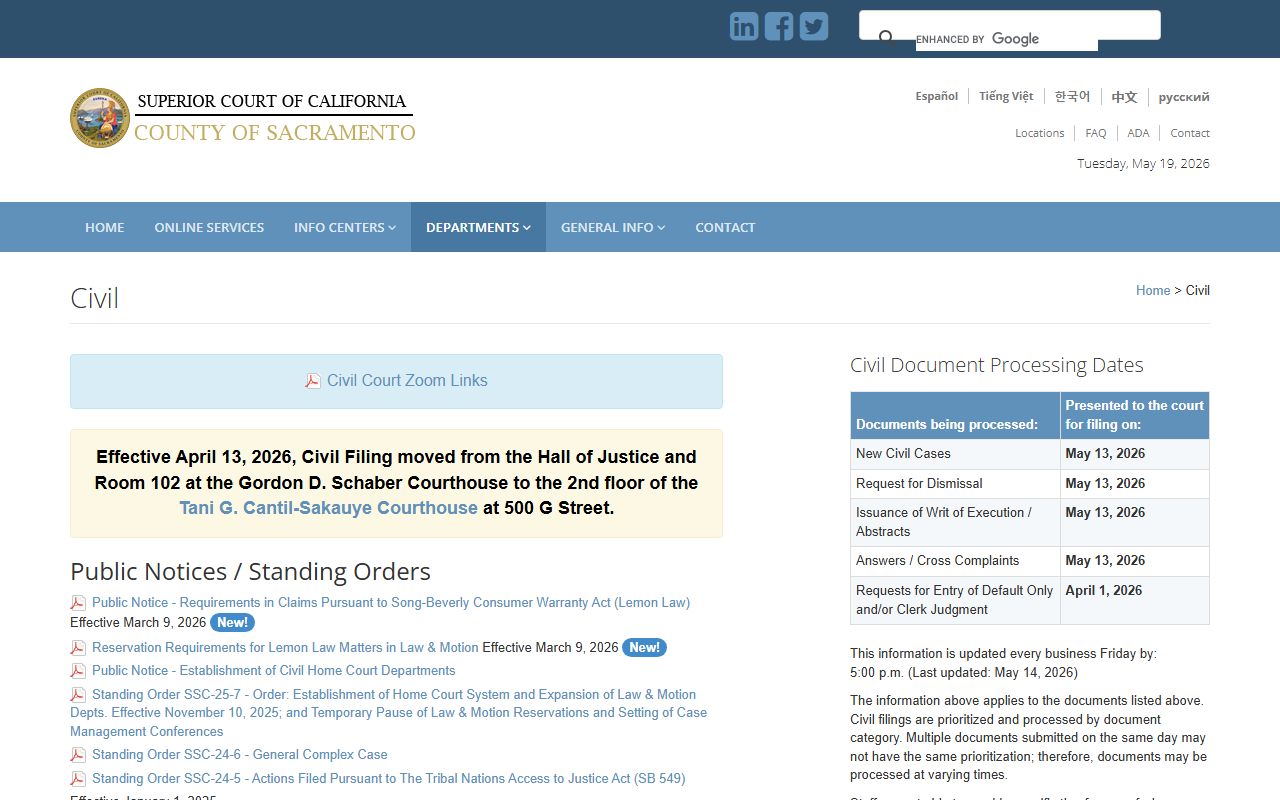
The civil division updates document processing dates every Friday by 5:00 p.m., which is helpful when a recent filing is missing from Public Case Access.
Sacramento County Court Locations
Sacramento Superior Court operates from several courthouses spread across the county. Most criminal and civil trial business happens downtown. Family law moved to a dedicated courthouse off Power Inn Road. Traffic, small claims, and some other high-volume calendars run out of the Carol Miller Justice Center. Juvenile matters are handled at the Juvenile Courthouse near Kiefer Boulevard. The full court locations index is at saccourt.ca.gov/locations.
Gordon D. Schaber Sacramento County Courthouse. 720 9th Street, Sacramento, CA 95814. Main trial courthouse. Adult criminal calendars, civil law and motion, probate, and most jury trials. Page: saccourt.ca.gov/locations/gch.aspx.
William R. Ridgeway Family Relations Courthouse. 3341 Power Inn Road, Sacramento, CA 95826. Family law division. Dissolution, custody, child support, restraining orders, and family court services.
Carol Miller Justice Center. 301 Bicentennial Circle, Sacramento, CA 95826. Traffic and small claims calendars and other assigned high-volume matters. The Sacramento Superior Court CMJC pilot first-quarter results were posted in August 2025.
Juvenile Courthouse. 9605 Kiefer Boulevard, Sacramento, CA 95827. Juvenile delinquency and dependency. Public access is governed by Welfare and Institutions Code section 827 and is sharply limited.
Each courthouse uses security screening at public entrances. Weapons are barred. Recording in a courtroom needs judicial permission under court rules. Visitors with disabilities can request accommodations through the court's accessibility process before the hearing date. Language access runs through the court's interpreter services page.
How a Case Moves Through the Sacramento Court System
The state court path is short on paper. A case is filed in Superior Court, tried in Superior Court, and may then be appealed to the Court of Appeal, Third Appellate District. After that, the Supreme Court of California can review the decision, but it does not have to. Federal questions and federal habeas review come later and live on a separate track.
State court path: Superior Court Trial › Court of Appeal, Third Appellate District (or Superior Court Appellate Division for limited civil and infractions) › Supreme Court of California.
Criminal flow: Arrest › Booking › Arraignment › Preliminary hearing or grand jury › Information or indictment › Pretrial motions › Trial › Sentencing › Appeal. Bench warrants, bail decisions, and probation events sit on this same line.
Civil flow: Complaint filed › Service of process › Answer or demurrer › Case management conference › Discovery › Law and motion › Settlement or trial › Judgment › Post-trial motions › Appeal.
Court calendars and dockets are not the same thing. A calendar tells you what is scheduled. A docket, also called a register of actions, tells you what has happened in a case so far. Both are reachable through court dockets and the case detail page in Public Case Access.
Appeals to the Court of Appeal, Third Appellate District
Sacramento County sits in the Third Appellate District of the California Court of Appeal. The court has its own building in Sacramento and reviews most felony, unlimited civil, family, and probate appeals from Sacramento Superior Court. The official page is at courts.ca.gov/3dca.htm. A snapshot of the Third Appellate District page is below.
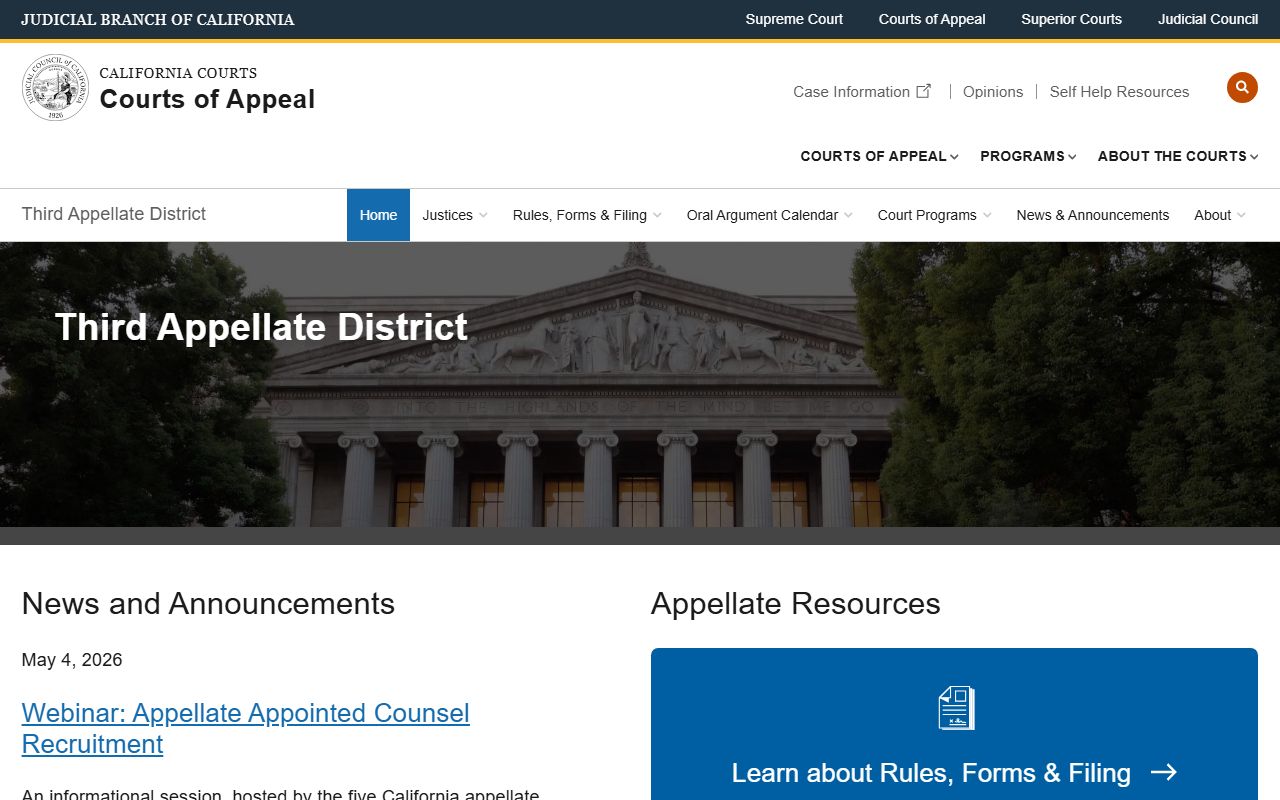
The Third Appellate District also covers other Northern California counties, but Sacramento generates a large share of its docket.
Small claims appeals and certain limited civil and infraction appeals follow a different path. They go to the Superior Court Appellate Division first, not directly to the Court of Appeal. Self-represented litigants should read the court's appellate self-help pages and confirm filing fees before submitting any notice of appeal. The Judicial Council forms used in California appeals are listed at courts.ca.gov/forms.htm.
California Supreme Court Review
The Supreme Court of California is the highest state court. It reviews selected civil and criminal cases, resolves split decisions from the Courts of Appeal, supervises statewide court administration with the Judicial Council, and automatically reviews death penalty appeals. Most Supreme Court review is discretionary. A party files a petition for review after losing in the Court of Appeal, and the high court decides whether to grant or deny it. The official page is at courts.ca.gov/supremecourt.htm.
For Sacramento County litigants, the practical takeaway is simple. State court review usually stops at the Court of Appeal. Supreme Court review is the exception. Federal courts are a separate system that comes into play only when a federal claim is involved.
The U.S. District Court for the Eastern District of California
Federal cases in Sacramento County belong to the U.S. District Court for the Eastern District of California. The trial court is housed at the Robert T. Matsui United States Courthouse in downtown Sacramento. The court's website is at caed.uscourts.gov, and a snapshot of its front page is below.
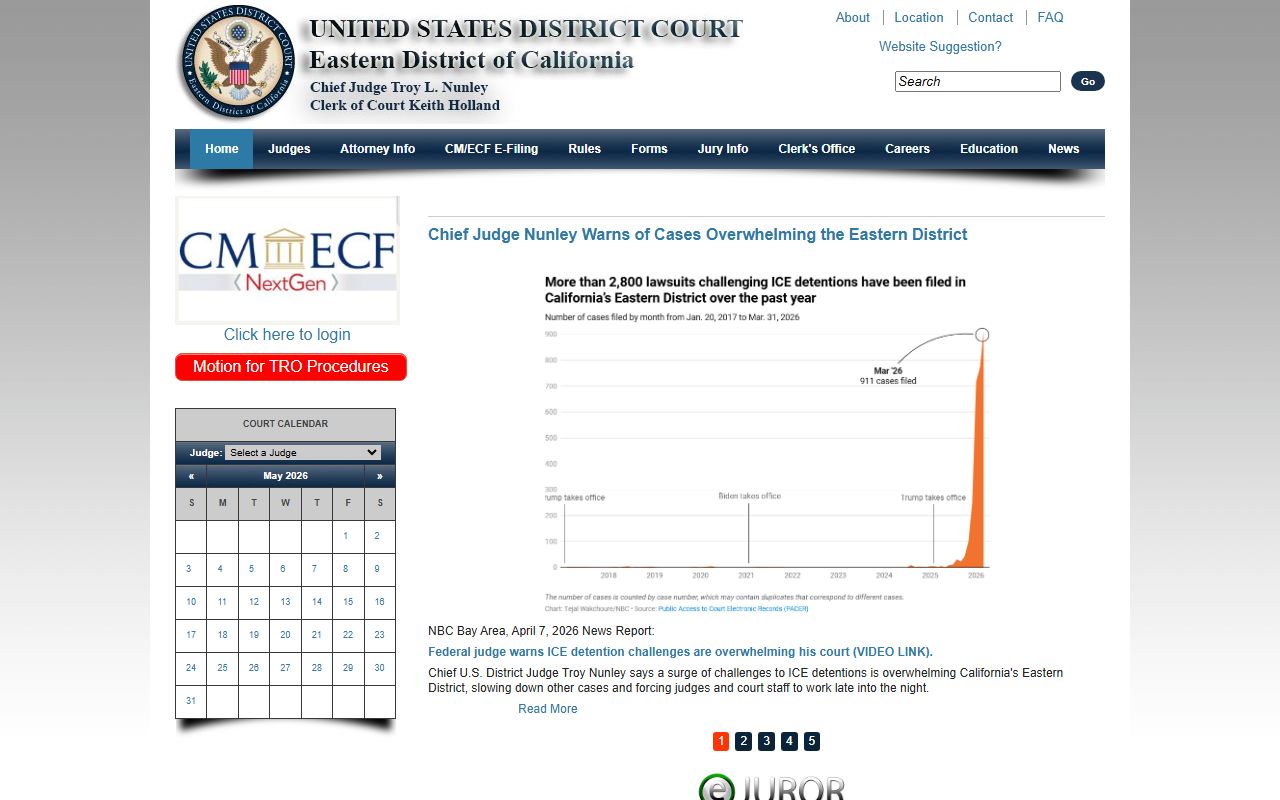
The Eastern District handles federal criminal prosecutions, civil rights cases, federal-question and diversity civil disputes, habeas petitions, and prisoner civil rights claims arising from Sacramento County and a large stretch of inland Northern California.
State and federal courts in Sacramento are not interchangeable. A side-by-side view helps.
| Topic | Sacramento Superior Court | U.S. District Court, Eastern District |
|---|---|---|
| Cases heard | California state criminal, civil, family, probate, juvenile, traffic, small claims. | Federal crimes, civil rights, federal-question and diversity civil, habeas, federal prisoner claims. |
| Source of law | California Constitution, Penal Code, Vehicle Code, Family Code, Probate Code, local rules. | U.S. Constitution, federal statutes, federal rules of civil and criminal procedure. |
| Online search | Public Case Access (free). | PACER (fee-based per page). |
| Filing fees | State filing schedule at saccourt.ca.gov/fees. | Federal filing schedule under 28 U.S.C. and judicial conference. |
| Appeals | Court of Appeal, Third Appellate District. | U.S. Court of Appeals for the Ninth Circuit. |
PACER and Federal Case Access
PACER is the federal courts' public case access system. It is a single login that reaches the Eastern District of California, the Bankruptcy Court, the Ninth Circuit, and every other federal court in the country. Account registration is at pacer.uscourts.gov. CM/ECF is the related electronic case filing system used by attorneys and is reachable at ecf.caed.uscourts.gov for the Eastern District.
PACER charges a per-page fee, capped per document, with a quarterly fee threshold below which the account is not billed. Free access exists for case opinions and some judicial orders. PACER is not free in the way Sacramento Superior Court's Public Case Access is free. Users running many searches should budget for the federal fee.
Bankruptcy Court for the Eastern District
Bankruptcy filings in Sacramento County go to the U.S. Bankruptcy Court for the Eastern District of California, not the Superior Court and not the U.S. District Court directly. The website is caeb.uscourts.gov. Chapter 7, Chapter 13, and most Chapter 11 cases for Sacramento County debtors are filed there. The bankruptcy court has its own clerks, docket, and electronic filing system. A snapshot of the court's page follows.
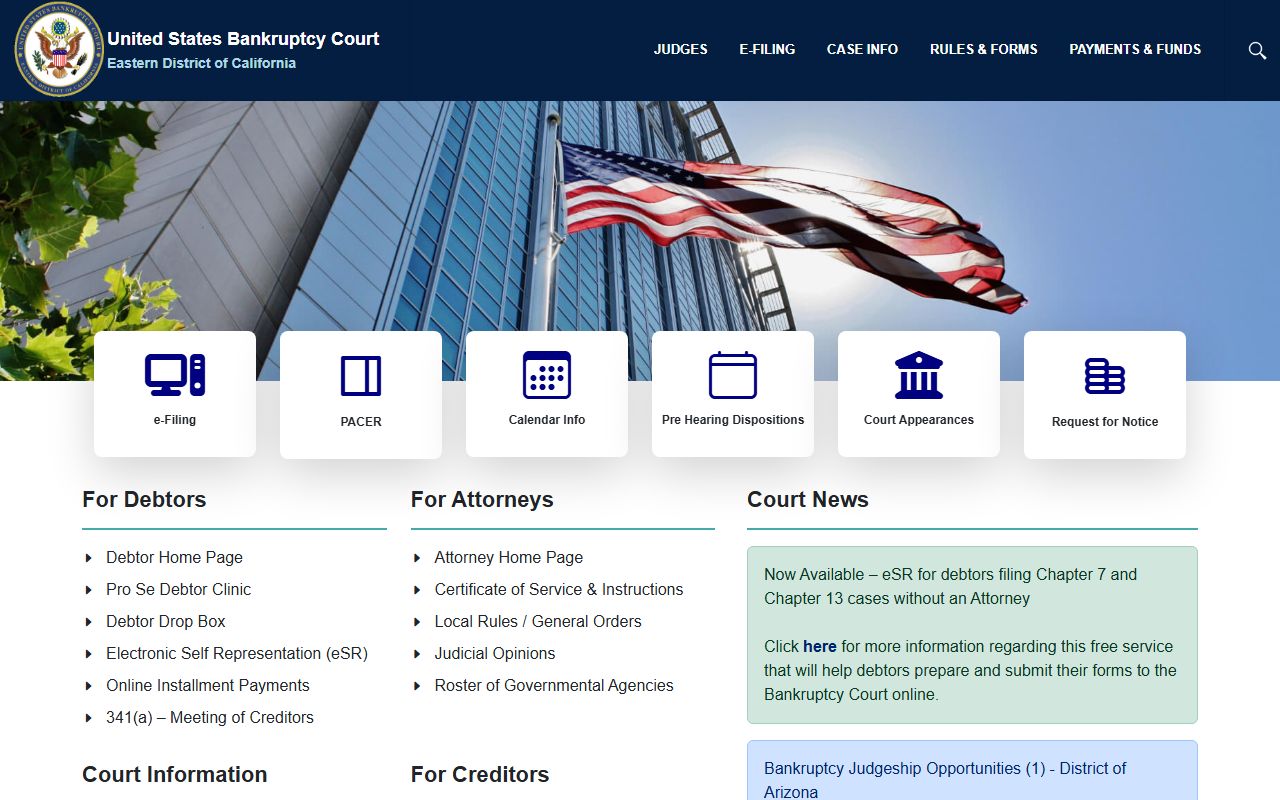
Bankruptcy cases are searchable through PACER once a debtor's case number or name is known.
Ninth Circuit Court of Appeals
Appeals from the U.S. District Court for the Eastern District of California go to the U.S. Court of Appeals for the Ninth Circuit. The Ninth Circuit hears federal appeals from California and eight other western states. The official site is at ca9.uscourts.gov. Federal prosecutions in Sacramento County are brought by the U.S. Attorney's Office for the Eastern District at justice.gov/usao-edca, and federal warrants and transport functions involve the U.S. Marshals Service Eastern District of California.
Specialty and Collaborative Courts in Sacramento
The Superior Court runs several collaborative court programs. These are problem-solving courts that pair judicial supervision with treatment, case management, and accountability. The court's collaborative courts page is at saccourt.ca.gov/collaborative-courts. Common programs cover drug treatment, mental health, veterans, and reentry. Eligibility is program-specific and depends on charge type, criminal history, clinical assessment, and willingness to participate. Treatment details inside these programs may be confidential even when the criminal docket is public.
Two real people connected to the Sacramento criminal system are worth knowing by name. Sacramento County District Attorney Thien Ho prosecutes felony and misdemeanor cases. Sacramento County Sheriff Jim Cooper runs the jail and law-enforcement side. The court does not prosecute, defend, or arrest. It hears the cases that come from those agencies.
How to Find Sacramento Court Forms
Most California court forms are statewide Judicial Council forms. Sacramento Superior Court uses these statewide forms for filings, plus its own set of local forms. The statewide form library is at courts.ca.gov/forms.htm. Sacramento local forms live at saccourt.ca.gov/forms. A snapshot of the local forms page is below.
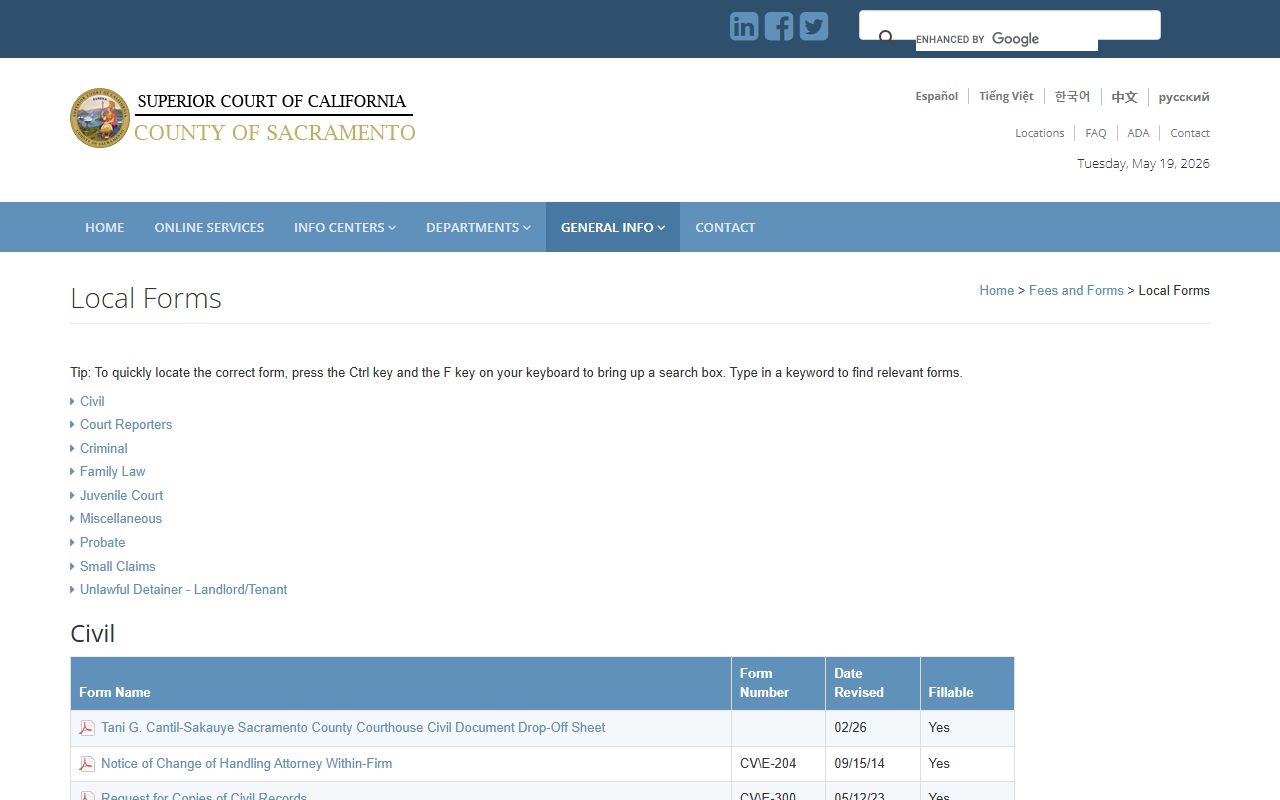
Pick the statewide Judicial Council form first if one exists. Drop in any required Sacramento local form on top. Local rules are at saccourt.ca.gov/local-rules.
- Civil and family. Use Judicial Council forms for petitions, responses, and orders, plus Sacramento local civil cover sheets.
- Probate. Judicial Council probate forms with Sacramento probate notes.
- Traffic and small claims. Statewide forms plus the local traffic and small claims handouts.
- Fee waivers. Statewide fee waiver application FW-001 with court review.
- Self-help. Statewide self-help at selfhelp.courts.ca.gov.
Recent Sacramento Superior Court Initiatives
Two recent changes affect how the court runs its civil and traffic dockets, and both matter for records searches.
The court launched the Civil Home Court model on November 10, 2025. Most civil cases, except prerogative writs of mandate, complex civil, unlawful detainer, probate, and civil harassment restraining orders, are now assigned to a single Civil Home Court Department for case management and law and motion. Departments 25, 28, 53, and 54 at the Gordon Schaber Courthouse and Hall of Justice were named in the court's announcement. A docket entry showing a department assignment early in a civil case now usually means the case has been routed to its Home Court Department.
The court also released an Online Trial by Declaration notice on December 11, 2025. The notice expanded online declaration-trial access for Sacramento County traffic respondents and is described in more depth on the traffic court records page.
Note: Judicial assignments change. Verify the current department and judicial officer through Public Case Access before relying on a name shown in older notice materials.