
Criminal Records in Sacramento County
Criminal records in Sacramento County come from more than one source. Police and the Sacramento County Sheriff create arrest and booking records. The District Attorney files charges. The Superior Court keeps the case file, the docket, and the judgment. The California Department of Justice keeps a state-level criminal history. Each source holds part of the story. No single public search gives the full picture. The Sheriff, led by Sheriff Jim Cooper, runs jail custody and intake. District Attorney Thien Ho, elected in 2022, prosecutes felony and misdemeanor cases in Sacramento Superior Court.
An arrest record is not the same as a criminal court record. An arrest record is generated at booking. A court record begins when the prosecutor files a complaint, information, or indictment. A conviction record exists only if a judge or jury entered a verdict, or the defendant entered a plea that ended in a guilty or no-contest finding. A case can have an arrest but no charges, charges but no conviction, or a conviction that was later dismissed under California Penal Code section 1203.4.
The court divides criminal work across courthouses. Most adult criminal calendars run at the Gordon D. Schaber Sacramento County Courthouse at 720 9th Street. The criminal division landing page links to calendars, payment options, and case access.
How to Search Sacramento County Criminal Records
The main public search is Sacramento Superior Court Public Case Access for criminal cases. The portal is free. The portal will not show sealed, dismissed-and-sealed, or juvenile cases. A search by case number is most accurate. A search by name plus date of birth is the fallback. The criminal portal screenshot below shows the main fields a user encounters.
For a view of the official criminal case search interface, see the Sacramento criminal case access page.
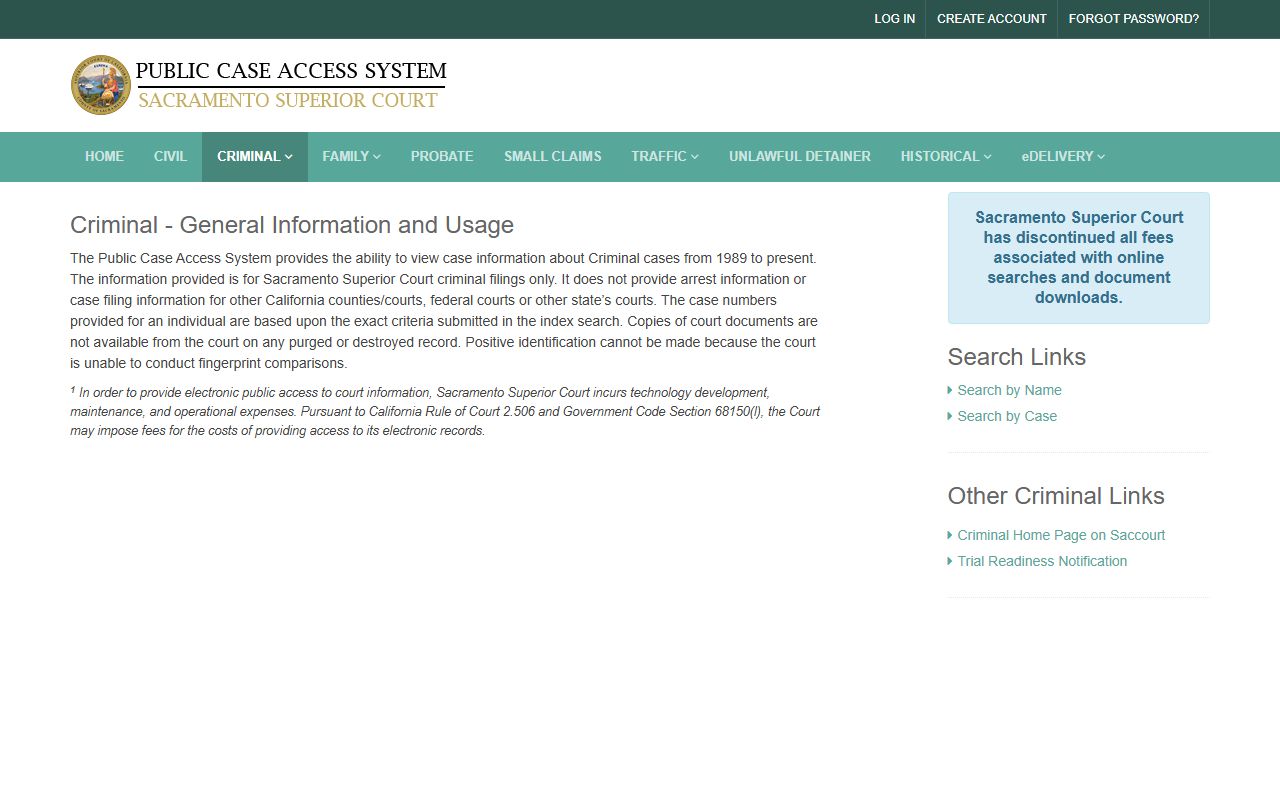
The criminal portal asks for a last name and date of birth in many person searches, which helps narrow false matches for common names.
- Open Public Case Access Criminal and read the field labels.
- If a case number is known, enter it first. The format depends on filing year and division.
- If only a name is known, type the last name first, then the first name.
- Add the date of birth if the search form asks for it. This cuts false matches on common names.
- Run the search and open each result to view the docket, charges, and disposition.
- If a person was just arrested but no court case yet appears, check the Sacramento Sheriff name search for booking status.
- For the searcher's own California criminal history, use the California DOJ Record Review process, not a third party.
The criminal case access portal exposes a small but useful set of search fields. The table below lists what to expect on the search form.
| Field | Type | Required | Notes |
|---|---|---|---|
| Case Number | Text | No | Best field when known. |
| Defendant Last Name | Text | Conditional | Use exact spelling; common names need more filters. |
| Defendant First Name | Text | No | Narrows defendant search. |
| Date of Birth | Date | Often requested | Used to reduce false matches on common names. |
| Search | Button | n/a | Runs the query. |
Arrest Records vs. Criminal Court Records in Sacramento County
An arrest is one step. A criminal court record is the rest of the process. The Sacramento County Sheriff publishes current custody data on the inmate information page. That data covers people in active jail custody. A person who was cited, released, transferred, or freed before the search will not appear there. To track what happened after booking, the case has to be filed in the Superior Court and then searched through Public Case Access.
| Arrest Record | Criminal Court Record | |
|---|---|---|
| Source | Sacramento Sheriff / arresting agency | Sacramento Superior Court |
| Created When | Booking and intake | Prosecutor files complaint or information |
| Contents | Booking date, charges, bail, holds, housing | Pleadings, hearings, plea, disposition, sentence |
| Where Searched | Sheriff name search | Public Case Access Criminal |
| Persistence | May leave search after release | Stays in the court file |
A no-result on the Sheriff page does not prove no arrest happened. A no-result on the court page does not prove no charges. Sealing, dismissal, juvenile status, and timing all affect what shows.
Charges vs. Convictions
The word "charged" and the word "convicted" are not the same. A charge is an accusation. A conviction is a finding of guilt. The difference matters for background screening, news reporting, and personal record review.
| Charge | Conviction | |
|---|---|---|
| Stage | Filed accusation by the DA | Verdict, guilty plea, or no-contest plea |
| Burden of Proof | Probable cause | Beyond a reasonable doubt |
| Result | Case proceeds | Sentence may issue |
| Public Record | Yes, in the case file | Yes, unless dismissed or sealed |
| Reversal | Can be dismissed or dropped | Can be appealed or relieved under PC 1203.4 |
What Sacramento County Criminal Records Show
A Sacramento criminal case docket and case file together include a defined set of fields. Some are open. Some are redacted. The list below mirrors what the Public Case Access portal commonly exposes for an open criminal case.
- Arraignment
- The first court appearance, where charges are read and rights are addressed.
- Plea
- The defendant's formal response: guilty, not guilty, or no contest.
- Disposition
- The current or final outcome of a charge or case.
- Sentence
- The court order imposed after a conviction. May include jail, prison, probation, fines, or restitution.
- Bail
- Money or conditions used to secure a defendant's appearance.
- Probation
- Court-supervised sentence served in the community under set conditions.
- Restitution
- Money ordered to compensate a victim.
- Bench warrant
- A warrant issued by the judge, often after a failure to appear.
Public docket data also includes the case number, case title, filing date, court department, judicial officer, charge code section (often a Penal Code, Vehicle Code, or Health and Safety Code citation), count number, charge level (felony, misdemeanor, infraction), and hearing schedule.
Sacramento County Mugshots and Booking Photos
California law restricts public release of some booking photos. The Sacramento Sheriff has applied that rule in recent press releases. A July 25, 2025 release about threats to the Main Jail stated that the booking photo was ineligible for public release under California law. A September 22, 2025 release said a booking photo was prohibited for release because the charges were classified as non-violent. See the July 25 release and the September 22 release as direct local examples. A criminal case can be public while the mugshot is withheld.
The legal split is simple. Arrest and charge information may be public. The booking photo itself is governed by separate California rules. A page that promises a mugshot for every booking in Sacramento County is overpromising. The Sheriff explains booking-photo policy through the official site.
For a view of the Sheriff's inmate information landing point, see the Sacramento Sheriff inmate information page.
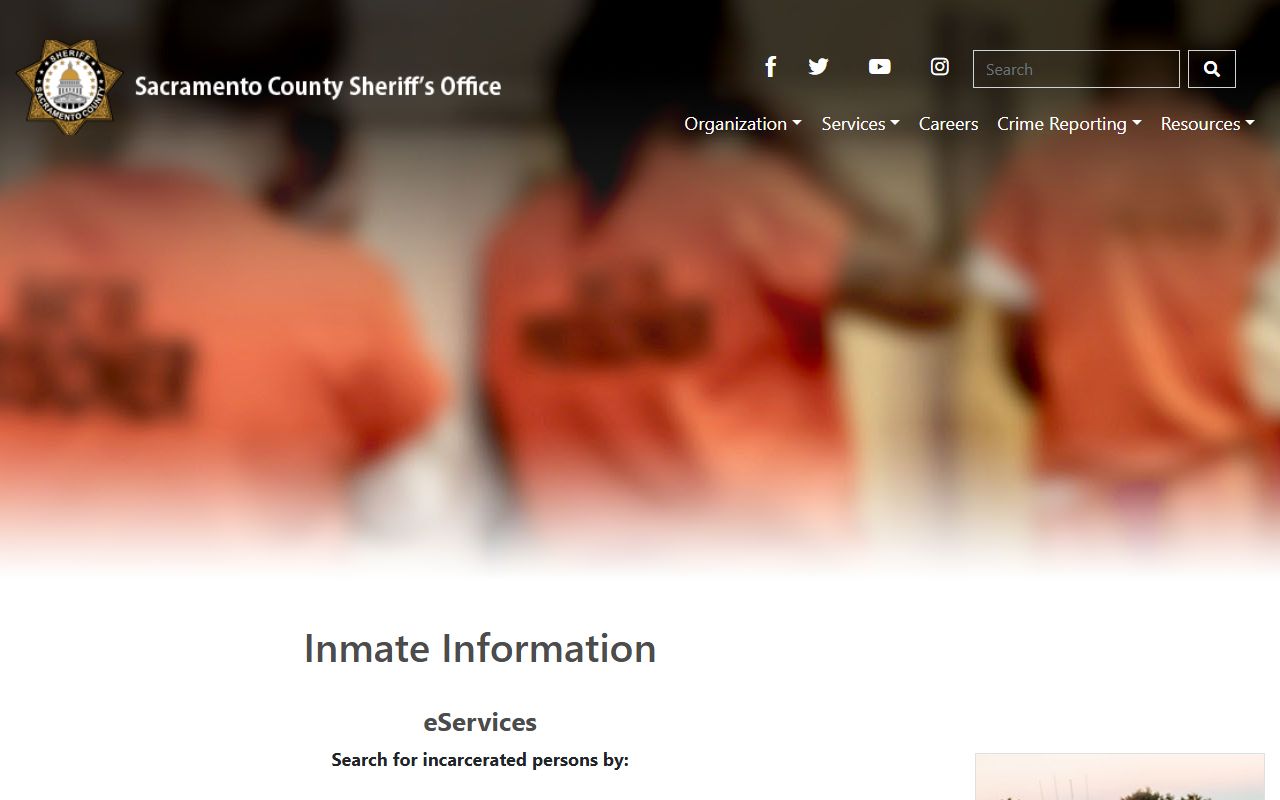
The Sheriff inmate page links the name search and the booking-photo policy together, so a missing mugshot can coexist with a confirmed booking record.
Sacramento County Sealed vs. Dismissed Records
"Expungement" is not the California legal term. California uses two main paths. The first is arrest sealing under Penal Code section 851.91 for many arrests that did not result in conviction. The second is dismissal relief under Penal Code section 1203.4 after probation or sentence completion, sometimes loosely called expungement. Each path has its own rules. Neither erases every government record.
| Arrest Sealing (PC 851.91) | Dismissal Relief (PC 1203.4) | |
|---|---|---|
| Targets | Arrest record | Conviction record |
| Eligibility | Arrest with no conviction in many cases | Conviction after successful probation in many cases |
| Effect on Public Record | Sealed from most public access | Conviction set aside for many purposes |
| Effect on Law Enforcement | Limited continued access | Continued access under statutory exceptions |
| Statute | PC 851.91 | PC 1203.4 |
Many sealing and dismissal petitions are denied because of an ineligible offense, a pending case, a missing element of proof, or a filing in the wrong court. A defense lawyer can help match the facts to the right statute.
Statewide Criminal Record Limits
California limits who can get an official state criminal history. The California Department of Justice runs the state criminal history system. Under the DOJ Record Review program, a person can request a copy of his or her own California record, but a third party cannot order another person's rap sheet through DOJ. The DOJ also publishes its criminal history dissemination rules for authorized agencies.
This is why a person looking for a friend's, partner's, or applicant's full California criminal history will not get it from DOJ. Authorized employers, licensing agencies, and law enforcement can receive a record through fingerprint-based Live Scan with statutory authority. Anyone else is limited to what is in public court files and to FCRA-compliant background screening providers that work from public court records.
Note: This site is not a consumer reporting agency under the Fair Credit Reporting Act, and the information here cannot be used for employment, tenant, credit, or other FCRA-regulated decisions.
Juvenile and Confidential Sacramento County Cases
California juvenile case files are confidential. Welfare and Institutions Code section 827 limits inspection to parties, attorneys, listed agencies, and others authorized by court order. Welfare and Institutions Code section 781 governs juvenile record sealing. Once a juvenile record is sealed, public access is blocked and the matter is treated, for most purposes, as if it did not occur.
Sheriff press releases tend to avoid juvenile names. A 2025 Sheriff release said suspects were taken into custody between the Main Jail and Juvenile Hall and that juvenile identities and juvenile court information were not readily public. That is a real local example of how adult and juvenile records are treated differently.
Other confidential or restricted categories include adoption files under Family Code section 9200, mental health treatment records under Welfare and Institutions Code section 5328, sealed search warrants in active investigations, and protected victim contact data in domestic violence and civil harassment cases.
Background Check Considerations
Most casual lookups are not background checks in the legal sense. A real background check used for employment, tenancy, credit, or licensing has to follow the Fair Credit Reporting Act, California civil rights rules, and industry rules. Public court records are useful for personal due diligence but cannot replace an FCRA-compliant report when the law requires one.
Important: Sacramento County Court Records is not a consumer reporting agency under the FCRA. Public record results on this site may not be used for employment, tenancy, credit, insurance, or any other FCRA-regulated decision.