
California Public Records Act Basics
The California Public Records Act, or CPRA, is the baseline open records law in California. It now sits at Government Code section 7920.000 and the sections that follow. Older legal sources cite the act at sections 6250 through 6276.48, but the legislature recodified the statute effective 2023 with no intent to change the substance. The text is online at leginfo.legislature.ca.gov. The legacy section 6254 page at leginfo Section 6254 is still useful for older citations.
The CPRA says records of state and local agencies are public unless a specific exemption applies. The California Constitution, Article I, section 3(b), backs the law with a constitutional right of access and a rule that access-limiting laws must be read narrowly. The Sheriff, DA, Public Defender, Board of Supervisors, Probation, Health and Human Services, and other county departments all follow the CPRA. Court case records do not. Court case records are governed by California Rules of Court 2.400 and 10.500 and by specific confidentiality statutes.
Lead-in image. The official CPRA text at leginfo.legislature.ca.gov is the source for any quoted statute language.
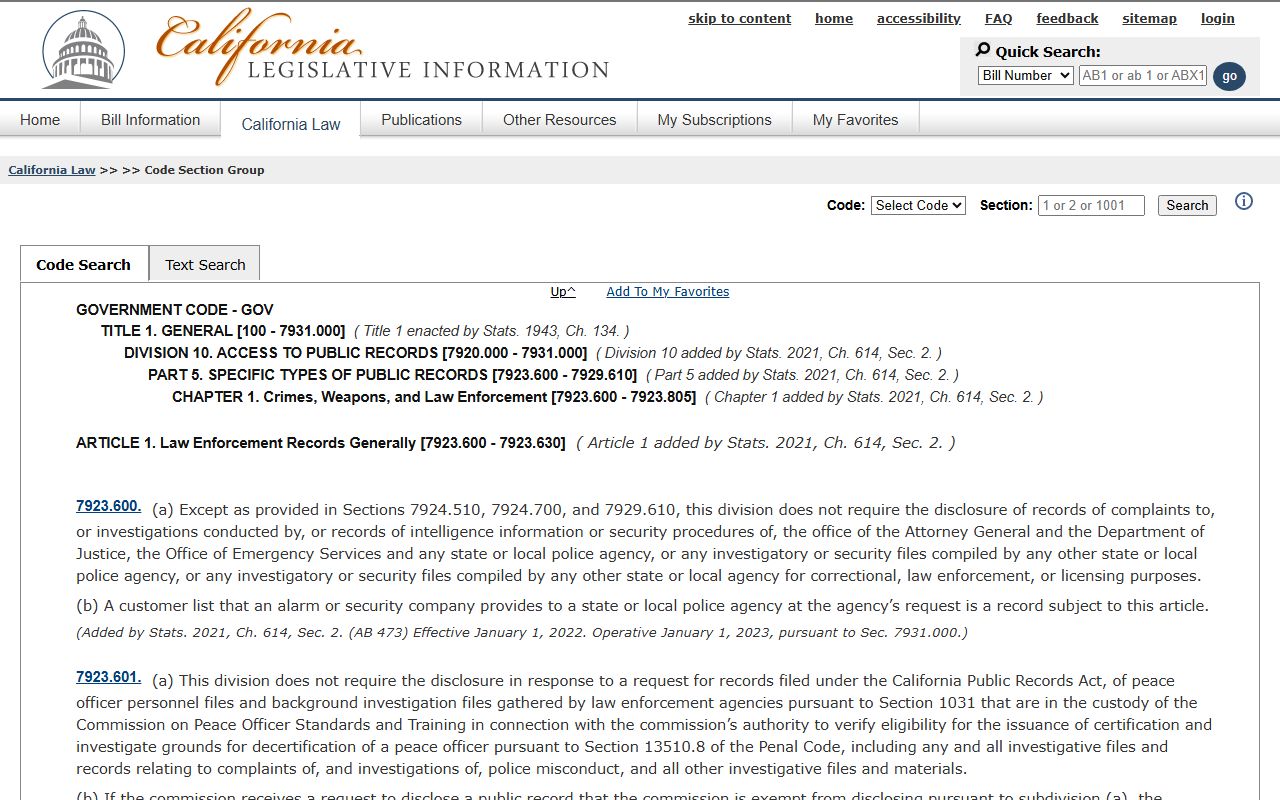
The recodified sections in the 7920 series carry forward the same exemption framework that was used under the old 6250 numbering.
Court Records vs County Agency Records vs Clerk/Recorder Records
Three custodians, three sets of rules, three request paths. The chart below shows the split at a glance.
| Record Type | Custodian | Governing Law | Request Method |
|---|---|---|---|
| Civil, criminal, family, probate, traffic case files | Sacramento Superior Court | California Rules of Court 2.400, 2.550, 2.551, 10.500 | Court records procedure or Public Case Access |
| Sheriff incident reports, DA admin records, county department files | County agency that holds the record | California Public Records Act, Gov. Code 7920.000 | CPRA written request to the agency |
| Recorded deeds, liens, marriage licenses, fictitious business names | Sacramento County Clerk/Recorder | Government Code, Civil Code, vital record statutes | Clerk/Recorder order or in-person request |
A request for a Sheriff use-of-force file goes to the Sheriff under the CPRA. A request for a divorce judgment goes to the Superior Court under court rules. A request for a marriage certificate goes to the Clerk/Recorder under vital record rules. Mixing the three is the most common mistake users make.
How to File a Sacramento County Public Records Request
A CPRA request is a written ask for identifiable agency records. The request does not need to cite the statute, but a clear description speeds the response. Each agency has its own request page or contact email.
- Identify the right custodian. Is the record a court file, a county agency file, or a Clerk/Recorder file? Send the request to that office.
- Write the request. Describe the records you want with specific dates, names, case numbers, or topics. Vague requests slow the process and may be denied as overbroad.
- Send the request. Most county offices accept CPRA requests by email, online form, mail, or fax. The Sheriff CPRA portal sits inside sacsheriff.com. The DA office is sacda.org. The Public Defender is pubdef.saccounty.gov.
- Wait for the determination. The agency has a short window to tell you whether it has the records and whether it will release them. Disclosable records are sent on a reasonable schedule.
- Review the response. If material is redacted, ask the agency to state the statutory or rule basis for each redaction. Narrow your request if the agency calls it overbroad.
- Pay any direct duplication cost the agency bills. Most agencies cannot charge for search or review time under the CPRA.
- If access is denied, follow the request-denial path: ask for a written exemption statement, consider a narrowed request, or seek court enforcement.
Sheriff Office Records
Sacramento County Sheriff records cover incident reports, arrest reports, calls for service, jail booking records, use-of-force records, and other operational files. Sheriff Jim Cooper runs the office. The Sheriff homepage at sacsheriff.com lists CPRA contacts. The Sheriff also posts public-records pages on disclosed law-enforcement records under SB 1421 and SB 16. Inmate roster information is public-facing through the inmate search but does not work as a full criminal history.
Booking photos can be limited. Recent Sheriff releases have noted that some booking photos are ineligible for release under California law, especially in non-violent cases. A user who asks for a mugshot may be told the photo cannot be released even when the arrest itself is on record. Juvenile arrest files are not public; juvenile records sit under Welfare and Institutions Code section 827 confidentiality. For inmate lookups, see Sacramento County inmate records.
Sacramento County Clerk/Recorder Records
Sacramento County Clerk/Recorder Florence Evans runs the office that holds recorded land documents, vital records, marriage licenses, fictitious business name statements, notary registrations, and other county clerk and recorder files. The site is ccr.saccounty.gov. The official records page is ccr.saccounty.gov/Pages/Official-Records.aspx. The fee schedule sits at ccr.saccounty.gov/Pages/Fees.aspx.
Land records are indexed by grantor and grantee, by document number, by recording date, and by document type. Marriage records are split into public and confidential licenses; access to confidential records is restricted to the parties. Birth and death records have eligibility rules under California Health and Safety Code. A general public requester gets an informational copy, while a person named in the record or a close relative can get an authorized certified copy. The Clerk/Recorder is the right office for any recorded instrument; it is not the right office for a court case file.
Lead-in image. The Clerk/Recorder homepage at ccr.saccounty.gov ties together vital records, marriage, and official land records.
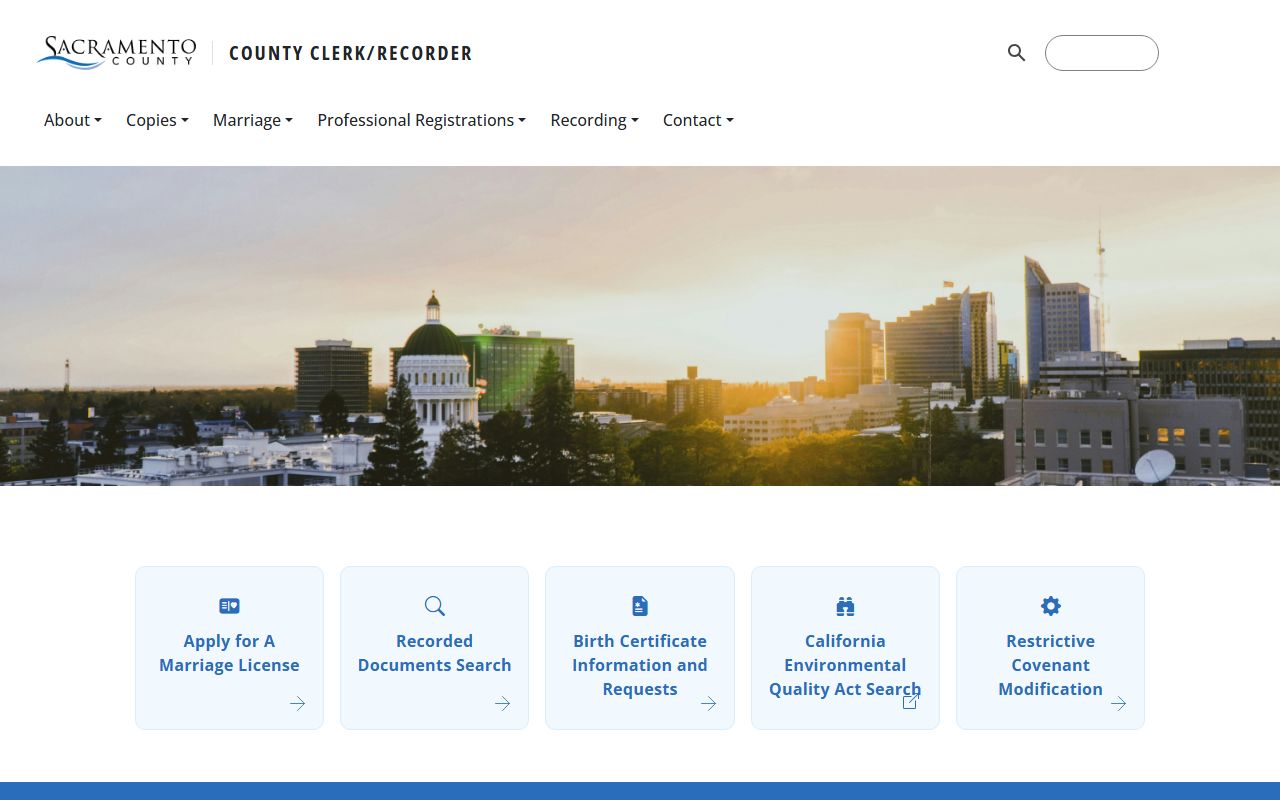
From the landing page, choose the service that matches the record you need rather than guessing at department names.
Court Records Public Access Framework
Court records are not CPRA records. Sacramento Superior Court files follow California Rules of Court 2.400 and 2.550, which set the open-by-default rule for trial court case files and the standard for sealing. Rule 2.551 sets the steps for filing a record under seal. Rule 10.500 covers judicial administrative records, which is the court system's CPRA-like rule for administrative files held by the court. Government Code section 68150 at leginfo Section 68150 sets the retention rules for trial court records and explains why old files may be archived or destroyed.
Case files are searched through the court's Public Case Access portal. Documents are sometimes viewable online and sometimes not. A user who needs a certified copy must use the court's records process. A sealed record is not viewable on the portal and is not released without a court order. Specific confidentiality statutes layer on top: Welfare and Institutions Code 827 for juvenile case files, Welfare and Institutions Code 781 for juvenile sealing, Welfare and Institutions Code 5328 for mental health records, Family Code 9200 for adoption, Penal Code 851.91 for arrest sealing, and Penal Code 1203.4 for dismissal relief.
Records That Are Exempt from Disclosure
California law exempts some records or some portions from public release. Common categories include personnel files, ongoing investigation records, attorney work product, privileged communications, records that would invade personal privacy, certain medical and mental health records, juvenile records, adoption records, and records sealed by court order. The exemption list is not a free pass. Agencies still must explain why each piece is held back and must release the rest of the file with non-exempt material visible.
- Personnel, medical, and similar files where disclosure would invade privacy.
- Ongoing investigation and intelligence records, with limited exceptions.
- Juvenile case files under Welfare and Institutions Code 827.
- Adoption records under Family Code 9200.
- Mental health treatment records under Welfare and Institutions Code 5328.
- Records sealed by court order under California Rules of Court 2.550 and 2.551.
- Attorney-client communications and attorney work product.
Fees and Copy Costs
The CPRA limits agency charges to direct duplication cost, plus any statutory fee set by another law. The agency cannot charge for staff time spent searching or reviewing in most cases. Court fees are different and are set on the court's fee page at saccourt.ca.gov/fees. Clerk/Recorder fees are at ccr.saccounty.gov/Pages/Fees.aspx. Each office posts the current rate. Use the official page before sending payment.
| Item | Source |
|---|---|
| CPRA per-page paper copy | Direct duplication cost per agency policy |
| Electronic record duplication | Cost of producing the copy under CPRA |
| Certified court copy | Sacramento Superior Court fee page |
| Exemplified court copy | Sacramento Superior Court fee page |
| Recorded document copy | Clerk/Recorder fee page |
| Certified marriage copy | Clerk/Recorder fee page |
Response Timelines Under California Law
The CPRA gives an agency 10 days to determine whether disclosable records exist and to tell the requester. The agency can extend the time by another 14 days in unusual cases such as the need to search field offices, the volume of records, or the need to consult with another agency. The 10-day window is not a deadline to deliver every record; it is a deadline for the determination. Actual delivery follows on a reasonable schedule.
A requester who hears nothing should follow up in writing. A written reminder helps build a record if the case ever needs to go to court. Court records do not follow the CPRA clock. Court records use the court's own process and timelines, which depend on the division and the type of record requested.
Challenging a Denial
A denial under the CPRA does not have to be the last word. The first step is to ask the agency for a written statement of the exemption basis. If a request is too broad, narrowing it can move it forward. If the agency holds firm, the CPRA allows a court petition. A successful petition can force release and can include attorney fees. Many California cities and counties also have local public-information ombudsmen or open-government commissions that handle complaints.
For court records, a sealing order can be challenged through a motion to unseal under California Rules of Court 2.551(h). A confidentiality designation can be lifted by court order on a showing of good cause and on findings consistent with the constitutional access right. Self-represented filers can use the court self-help page at saccourt.ca.gov/self-help for starting forms.
Privacy Rules in California Public Filings
California Rules of Court rule 1.201 protects personal identifiers in court filings. Social Security numbers, financial account numbers, and other personal identifiers must be redacted in public filings unless legally needed. Filers should not include full SSNs, full account numbers, or birth dates of protected persons in any filing that will be public. The court relies on filers to redact, and parties can move to redact when a public filing exposes too much.
The CPRA also has a privacy balancing test for personal information. An agency must redact information whose release would clearly outweigh the public interest in disclosure. Domestic violence victim addresses, sexual assault victim identifiers, and confidential informant information are common redaction categories. Sealed booking photos are another common example. Public access is real, but it is not unlimited.