
How Sacramento County Marriage and Divorce Records Are Split
The state of California treats marriage records and divorce records as two different kinds of files. A marriage license is a county vital record. A divorce judgment is a court case record. The Sacramento County Clerk/Recorder, led by Florence Evans, runs the marriage license process and keeps certified copies of recorded marriages. The Sacramento Superior Court runs the dissolution process and keeps the family law case file. The two systems do not share a single search page. A reader who needs proof of marriage uses the Sacramento County Clerk/Recorder. A reader who needs proof of divorce uses Sacramento Superior Court at saccourt.ca.gov family law.
Mixing the two offices wastes weeks. The Clerk/Recorder cannot give out a divorce judgment, and the family law clerk cannot give out a marriage certificate. A user who asks the Clerk/Recorder for a divorce decree will be sent back to the court. A user who asks the court for a marriage certificate will be sent to the Clerk/Recorder. Knowing the split before you call saves time.
Sacramento County Marriage License Office
Marriage license services in Sacramento County run through the Clerk/Recorder marriage page at ccr.saccounty.gov/Pages/Marriage.aspx. The office issues both public and confidential marriage licenses, takes appointments for in-office civil ceremonies, and sells certified copies after the marriage is recorded. The Clerk/Recorder is also the office that issues fictitious business name filings, notary registrations, and recorded land records. A marriage license is valid statewide once issued.
California rules on marriage are simple but strict. Both people must show valid government photo ID. Both must appear in person for the license. Neither party can be married to someone else at the time of the license. No blood test is needed. No waiting period sits between getting the license and the ceremony, so a couple can get the license in the morning and marry that afternoon. The license itself is good for 90 days, after which it expires and a new license must be issued. Same-sex couples have the same rights as any other couple under California law.
The Clerk/Recorder posts current marriage hours, locations, and appointment rules on the office locations page. Sacramento has multiple branch locations for some services. The downtown office is the main point of contact for marriage licenses and civil ceremonies.
How to Apply for a Sacramento County Marriage License
The license must be issued before the ceremony, never after. Both people apply together. Steps follow the Clerk/Recorder marriage page.
- Open the Clerk/Recorder marriage page at ccr.saccounty.gov/Pages/Marriage.aspx and read the current requirements.
- Pick the license type. A public marriage license is the standard form and creates a public record. A confidential marriage license is for couples already living together as spouses and carries stricter access rules.
- Book a marriage license appointment online or by phone. Walk-in service may not be offered for all hours.
- Bring valid, current government photo ID for each person. The name on the ID must match the legal name used on the license.
- If either party was married before, bring the date and place the prior marriage ended. The form asks for it.
- Pay the current license fee from the Clerk/Recorder fee page at ccr.saccounty.gov/Pages/Fees.aspx. Confidential licenses cost more than public ones.
- Sign the license in front of the Clerk/Recorder staff. Both people must sign.
- Get married within 90 days. The officiant must complete and return the license for recording. Once it is returned and recorded, certified copies can be ordered.
Public vs Confidential Marriage Licenses
California offers two license types and they are not the same record. A public license is the default. Anyone who meets the vital-record copy rules can request a certified copy of a public marriage record from the Clerk/Recorder. The marriage is also indexed in public marriage files. A confidential license is different. Family Code rules require the couple to already be living together as spouses at the time of the application. Witnesses are not required at the ceremony. The record is not searchable by the general public, and only the parties to the marriage, or someone with a court order, can usually request copies.
Confidential licenses carry a higher fee and stricter access. They are popular with couples who want privacy. Anyone trying to look up a confidential marriage from outside the marriage will run into copy restrictions. Knowing which type you have, or which type you are looking up, matters before you pay for any copy.
Marriage License Fee Schedule
Fees are set by the Clerk/Recorder and change. The office posts the current schedule at ccr.saccounty.gov/Pages/Fees.aspx. Use that page before you send payment. The chart below shows the items billed; check the Clerk/Recorder fee page for the current amount.
| Item | Office | Amount |
|---|---|---|
| Public marriage license | Clerk/Recorder | See Clerk/Recorder fee page |
| Confidential marriage license | Clerk/Recorder | See Clerk/Recorder fee page |
| Civil ceremony in office | Clerk/Recorder | See Clerk/Recorder fee page |
| Certified copy of marriage record | Clerk/Recorder | See Clerk/Recorder fee page |
| Divorce petition filing | Sacramento Superior Court | See saccourt.ca.gov fees page |
| Certified divorce judgment copy | Sacramento Superior Court | See court fee page |
Fee waivers are possible for low-income filers in court matters. The court explains fee waiver rules through the self-help page at saccourt.ca.gov/self-help.
Certified Copies of Sacramento County Marriage Records
A certified copy of a marriage record is the only kind most agencies will accept. Banks, name change requests, immigration filings, insurance, and Social Security usually need a certified copy with the Clerk/Recorder seal. A plain printout from a search has no legal weight. The Clerk/Recorder posts certified copy rules and identification requirements on its main site at ccr.saccounty.gov.
Eligibility differs by license type. Public marriage certified copies follow vital record rules. Confidential marriage copies are limited to the parties named on the license or a court-authorized person. The requester usually must show photo ID and complete a sworn statement of eligibility. Mail requests follow specific notary rules. Couples should not wait until a trip, name change, or insurance deadline to order copies. Recording and processing take time.
Lead-in image. The Clerk/Recorder homepage at ccr.saccounty.gov is the entry point for marriage licenses, vital records, and recorded documents.
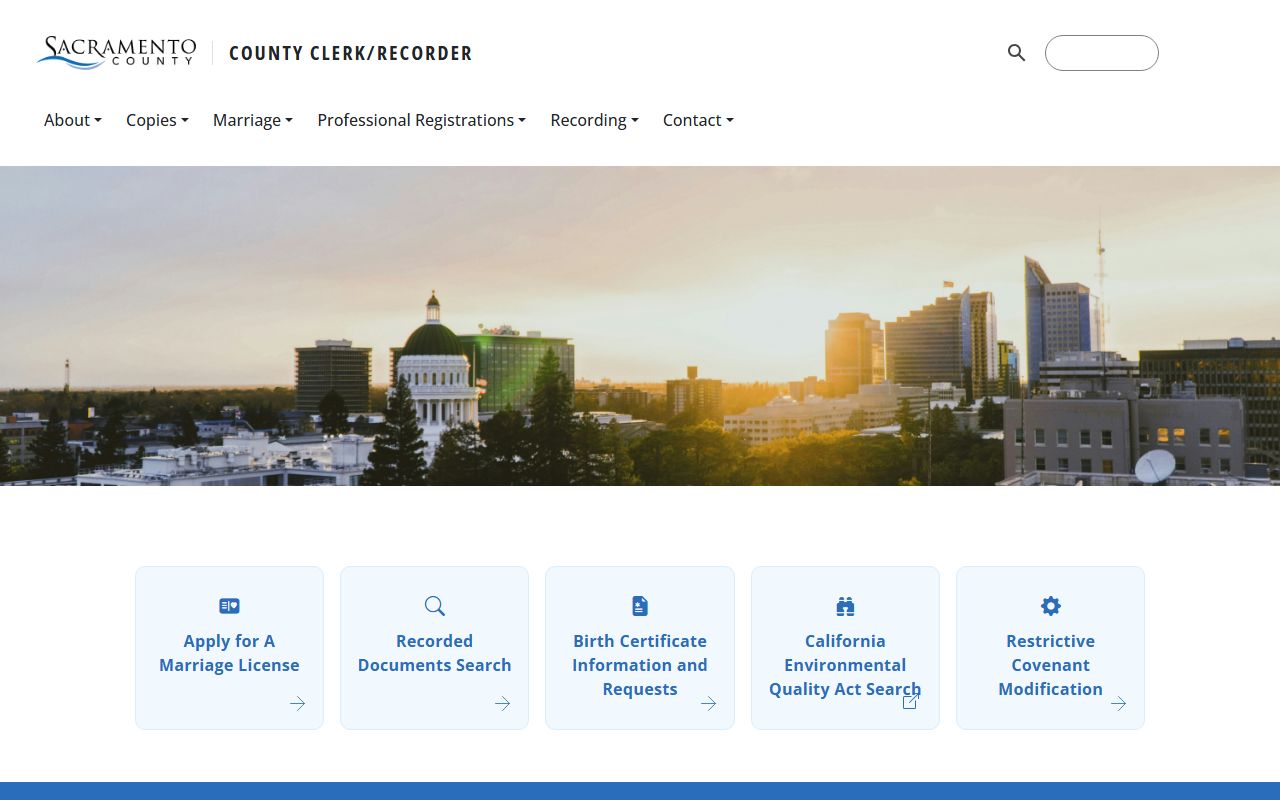
The site groups marriage, vital records, official land records, and fee schedules into a single navigation, so a user who lands in the wrong section can correct course in one click.
Sacramento County Divorce Records Online
Divorce in Sacramento County is filed and stored at Sacramento Superior Court family law. The case search portal is the Family branch of Public Case Access at services.saccourt.ca.gov/PublicCaseAccess/Family. The portal lets the public look up family cases by case number or party name. Dissolution, legal separation, parentage, custody, support, and domestic violence restraining orders all live in this portal. The official family law landing page is saccourt.ca.gov/family, and forms are at courts.ca.gov/forms.htm.
Public access has limits. The register of actions usually shows case events: petition filed, summons issued, response filed, hearings set, judgment entered. Documents involving children, custody evaluations, financial disclosures, and confidential addresses may not be downloadable. Some records are sealed. A user who only needs proof of divorce should ask the court clerk for a certified copy of the judgment rather than try to scrape every page from the portal.
Lead-in image. The Family Public Case Access portal at services.saccourt.ca.gov/PublicCaseAccess/Family is the official family-case search interface.
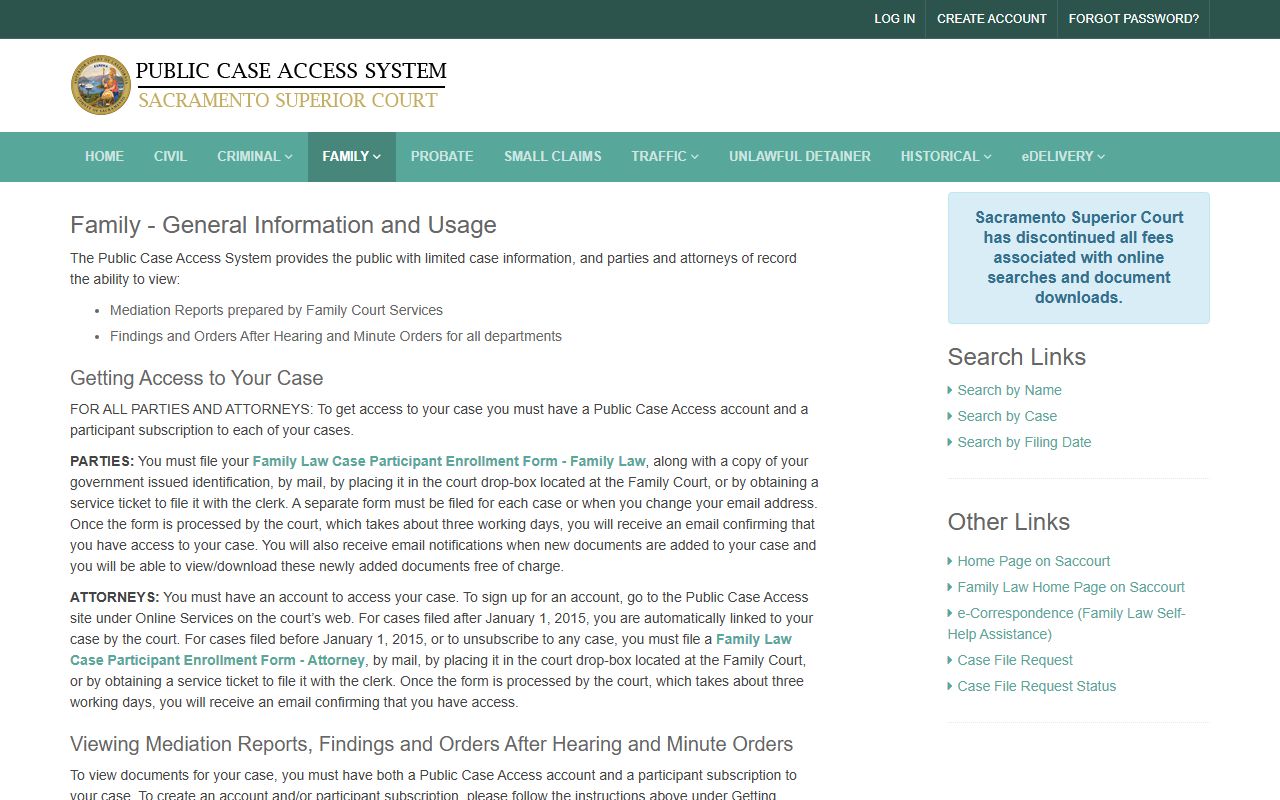
Search by case number first when known, then by last name. Add filing date range to narrow results when the surname is common.
How to File for Divorce in Sacramento County
Divorce uses statewide Judicial Council forms plus any Sacramento local forms. The general path is the same for most uncontested and contested cases.
- Confirm California residency. One spouse must have lived in California for at least six months and in Sacramento County for at least three months before filing.
- Pull the Judicial Council family law forms from courts.ca.gov/forms.htm. The petition (FL-100), summons (FL-110), and any child-related forms are the core packet.
- File the petition in Sacramento Superior Court family law at the William R. Ridgeway Family Relations Courthouse, 3341 Power Inn Road, Sacramento, CA 95826.
- Pay the filing fee or apply for a fee waiver using FW-001 if you qualify.
- Serve the other spouse with the petition and summons. Service must follow California rules. The filer cannot serve the papers personally.
- File the proof of service. The clock for the response runs from service.
- Complete preliminary financial disclosures unless legally waived. Each spouse exchanges income, asset, and debt information.
- Reach agreement, take a default if the other side does not respond, or set the case for hearing or trial.
- If children are involved, attend court-ordered child custody recommending counseling before contested custody hearings.
- Submit the judgment packet (FL-180 and supporting forms). The court enters judgment when paperwork is complete.
- Marital status terminates after the mandatory waiting period of at least six months from the date the responding party was served, even if the parties agree quickly.
Sacramento Family Case Search Fields
The Family Public Case Access portal exposes a small set of search fields. Knowing them ahead of time saves time and helps narrow common-name searches.
| Field | Type | Required | Notes |
|---|---|---|---|
| Case Number | text | No | Best search when known. Format depends on filing year. |
| Party Last Name | text | Conditional | Searches petitioner, respondent, or other party. Exact spelling helps. |
| Party First Name | text | No | Narrows common surname results. |
| Filing Date Range | date range | No | Useful for divorce or custody cases when the year is known. |
| Search | button | n/a | Runs the query against the family index. |
California Divorce Process Details
California is a no-fault divorce state. The standard ground for dissolution is irreconcilable differences. Neither spouse has to prove adultery, cruelty, or abandonment. This shortens many cases and removes the need for ugly fault evidence. Property is divided as community property in most cases. Earnings and assets gained during marriage are usually shared equally. Separate property stays with the original owner.
The six-month waiting period is set by state law. It runs from the date the responding spouse is served, not from the date the petition is filed. Even an uncontested divorce with full agreement cannot end the marriage before that date. Spouses can sign judgment paperwork sooner; the court will enter the judgment, but the actual termination of status waits for the six-month mark or later.
Annulment is not the same as divorce. Annulment treats the marriage as void or voidable for legal reasons such as fraud, force, bigamy, incest, or lack of capacity. Legal separation does not end the marriage; it sets up custody, support, and property orders while the couple stays married on paper. People searching for proof of divorce should be careful not to confuse a separation judgment with a dissolution judgment.
Custody and Support Records Access Limits
Custody and support information sits in the family court file but carries special protection. Court orders are usually public on the register of actions, but underlying child custody evaluations, mediation reports, financial declarations, and parenting plans may be limited to the parties and their attorneys. Family Code and California Rules of Court protect minors, abused parties, and people with confidential addresses.
The court provides confidential address programs for domestic violence survivors. A person whose address is protected under a court order will not see the address on the public docket. Anyone searching family records should expect redactions in cases involving children, restraining orders, or financial disclosures. A docket entry without a document image is still a real event; you may need to ask the court for a copy through the records process if you have a right to it.
Officiants and License Return Rules
The marriage is not legally recorded until the license is returned. California recognizes ceremonies by clergy of any religion, by current or retired judges and commissioners, and by certain authorized civil officiants. A friend or family member can serve as a Deputy Commissioner for a Day in Sacramento County through the Clerk/Recorder program when offered. The officiant must complete the marriage section of the license, sign it, and return it to the Clerk/Recorder within the time set by state law.
A ceremony where the license is never returned can leave the couple legally unmarried on paper, even after a wedding. That problem creates real headaches for name changes, insurance, immigration, and Social Security. After return and recording, certified copies become available. Couples should request first copies soon after the wedding rather than wait until they are needed.