
How to Look Up Sacramento County Jail Population Data
Sacramento County does not publish a single live population dashboard the way some larger cities do. Population numbers are pulled from several official sources. The Sheriff's facility pages at sacsheriff.com describe each site. The California Board of State and Community Corrections (BSCC) at bscc.ca.gov runs the statewide jail profile that includes Sacramento County. The federal Bureau of Justice Statistics at bjs.ojp.gov issues national jail reports with state and county data tables.
The most useful Sacramento-specific source is the 2025 Jail Population Reduction Plans Status Report covering January through June 2025. It is hosted at dce.saccounty.gov. The report tracks average daily population, bookings, releases, length of stay, and reduction-plan goals for the period. It is the right starting point for any recent Sacramento population claim. The image below shows the BJS landing page, where national jail data tables live.
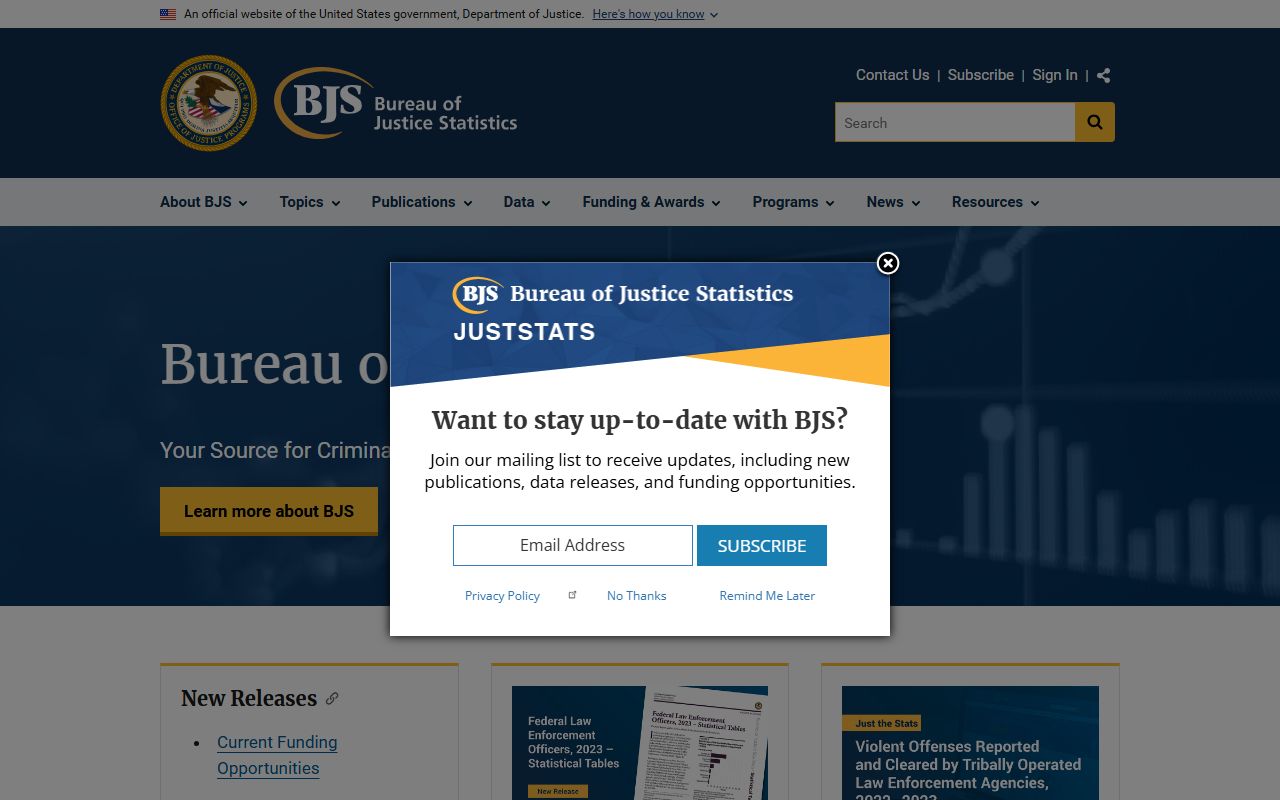
The BJS site holds the Annual Survey of Jails and the Jail Inmates report, both of which let a reader put Sacramento numbers in context against other large county jails. State context comes from the BSCC site.
Sacramento County Jail Capacity Overview
The Sheriff runs two main custody sites. The Main Jail at 651 I Street is a high-rise intake and pretrial holding tower in downtown Sacramento. It sits next to the courthouse and handles many newly booked arrestees and court-transport traffic. RCCC at 12500 Bruceville Road in Elk Grove is a larger correctional center with multiple housing units, programming space, and sentenced housing. The table below holds the official-source status for capacity at each site. Capacity numbers are not pinned without a fresh BSCC pull, so the cells are flagged.
| Facility | Function | Capacity (official source) |
|---|---|---|
| Sacramento County Main Jail | Intake, pretrial custody, court-adjacent housing | RESEARCH GAP: capacity not confirmed; verify with the current BSCC jail profile. |
| Rio Cosumnes Correctional Center | Pretrial and sentenced custody, programming | RESEARCH GAP: capacity not confirmed; verify with the current BSCC jail profile. |
Note: a public claim about Sacramento County jail capacity should always cite the BSCC jail profile or the latest county budget number, since older online citations may not match the current rated bed count.
Average Daily Population
Average daily population, or ADP, is the standard measure for jail size. It is the average number of inmates held each day during a reporting period. ADP can swing month to month based on arrests, court delays, transfers, and release policy. A Sacramento ADP claim should always come with a clear date range. The 2025 Jail Population Reduction Plans Status Report at dce.saccounty.gov is the right Sacramento-specific source for ADP during the first half of 2025.
RESEARCH GAP: the exact Sacramento County ADP for the latest reporting period was not pinned to a confirmed number in this research pass. The 2025 status report should be opened to extract ADP for January through June 2025, and the BSCC jail profile should be checked for the most recent statewide reporting cycle. A safer general statement is that Sacramento County, with two custody sites and a large urban catchment, runs an ADP among the higher county jails in California. Specific counts must come straight from the named reports.
Demographic Breakdown
Demographic data for the Sacramento County jail population is reported in the same county and state documents that hold the ADP. The 2025 status report should be checked for any race, ethnicity, sex, or age breakdown for the reporting window. BSCC jail data and BJS jail surveys add statewide and national context. RESEARCH GAP: a confirmed Sacramento County demographic split was not pinned in this research pass. Publishing a demographic claim without the source year and table would be misleading.
What the demographic data shows in most California county jails is a population that is mostly male, with smaller but significant women's housing, and a racial mix that tends to differ from the general county population. The drivers of that gap are complex and best read through the Vera Institute incarceration trends pages, the Public Policy Institute of California, and the BSCC reports rather than guessed at on a records page. The DOJ criminal history dissemination page at oag.ca.gov/fingerprints/security covers how individual criminal history is used, which is a related but separate topic.
Pretrial vs Sentenced Population
A county jail is not the same as a prison. The mix of people held is split between pretrial and sentenced groups, and that split matters for how the population should be read. Many Sacramento County jail beds hold people who have not been convicted. They are in custody because bail was set above their means, because a judge ordered detention, or because a warrant or hold blocks release. Other beds hold people serving a county jail sentence of a year or less, or a longer realignment sentence under Penal Code section 1170(h). The comparison table below sums up the differences.
| Group | Why Held | Where in Process | Length of Stay |
|---|---|---|---|
| Pretrial | Awaiting arraignment, hearing, or trial; bail not posted or denied | Case is open in Superior Court; no conviction yet | Days to many months, driven by court calendar |
| Sentenced (local) | Convicted; serving misdemeanor or felony jail term | Sentencing complete; serving time in county jail | Days to multiple years under realignment |
| Holds | Held for another agency, parole, probation, or out-of-county warrant | Varies; case may be local or elsewhere | Days to weeks pending transfer |
The 2025 Jail Population Reduction Plans Status Report is the right Sacramento source for the live pretrial-versus-sentenced split. Statewide context comes from BSCC and from California Department of Justice criminal justice statistics.
Misdemeanor vs Felony Population
Sacramento County jails hold both misdemeanor and felony defendants. Misdemeanor housing is common for short county jail sentences of less than a year and for pretrial holds on charges like DUI or domestic violence. Felony housing is used for more serious charges, for longer realignment sentences, and for pretrial holds on cases with high bail or no-bail conditions. The charge mix shifts over time with changes in state law, charging policy by the District Attorney at sacda.org, and bail reform decisions by the Superior Court.
A clean misdemeanor versus felony breakdown for a given quarter should come from the county reduction-plan report or from the BSCC jail profile. A public claim that "most jail inmates are felons" or "most are misdemeanor" is not safe without a current source. Charging trends and pretrial release rules can move the line quickly.
Mental Health and Medical Population
Jail medical and mental health detail is not public at the inmate level. System-level reports do cover staffing, programs, and litigation pressure. Sacramento County is under the Mays consent decree, a long-running federal civil rights case that has shaped jail mental health care. The September 5, 2025 county budget article at saccounty.gov describes a Board of Supervisors revision to the approved 2025-26 budget that includes Sheriff Intensive Outpatient Program expansion funding. The article states that $0.5 million Net County Cost was recommended for 1.0 FTE Sheriff Sergeant and 4.0 FTE Deputy Sheriff positions needed for the IOP expansion to comply with the Mays consent decree.
That budget line is one of the clearest public signals of jail mental health programming pressure in Sacramento County. It does not give a count of inmates needing mental health care, but it ties staffing and program growth to consent decree compliance. The 2025 status report should be checked for any mental health caseload or program-participation figures. Statewide mental health data lives in BSCC reports and the California Health and Human Services Open Data Portal.
National and State Context
Sacramento County's jail population is best read alongside state and national benchmarks. The federal Bureau of Justice Statistics at bjs.ojp.gov publishes the Annual Survey of Jails and the Jail Inmates report. Those reports give national jail incarceration rates per 100,000 residents and let a reader place Sacramento County against other large urban counties. The California BSCC at bscc.ca.gov publishes jail profiles, inspection reports, and standards used to compare California county jails.
A clean comparison is the rate per 100,000 county residents. National rates and California rates both shift each year. The image below shows the Bureau of Justice Statistics landing page where national rate tables are released. A specific rate claim for Sacramento County should be sourced to the most recent BJS or BSCC publication.
Federal context also matters because some Sacramento residents in custody are held in federal facilities, not county. Those people show in the Bureau of Prisons system rather than the Sheriff's roster.
Population Trends and Reduction Efforts
Sacramento County has spent the last several years on a stated path of reducing jail population through pretrial services, mental health diversion, and faster court processing. The 2025 Jail Population Reduction Plans Status Report at dce.saccounty.gov tracks the goals and the actual numbers for January through June 2025. The report is the right place to find current trend lines, stated obstacles, and any consent decree compliance steps.
Pandemic-era policy still casts a shadow on the numbers. Many California counties cut bookings and released low-level offenders early in 2020 and saw populations later rise as courts caught up on backlog. Sacramento's pattern roughly tracks that statewide curve. A claim about a specific year over year change should come from a named report, not a memory of past coverage. The Mays consent decree, the IOP expansion in the 2025-26 county budget, and the formal reduction plan all push in the direction of fewer jail beds used at a time. Whether the trend holds in the next quarter depends on arrest volume, court calendar speed, and bail decisions, which the public reports cover with date stamps.
Where the Data Comes From
Sacramento County jail population data flows from a layered set of sources. The Sheriff's facility pages describe the sites. The county budget process and the Department of Community and Environmental Services publish reports like the 2025 Jail Population Reduction Plans Status Report and the 2025-26 budget article. The California BSCC at bscc.ca.gov publishes county-by-county jail profiles, inspection reports, and statewide totals. The federal Bureau of Justice Statistics at bjs.ojp.gov publishes national jail data tables and lets a reader pull state-level summaries.
Each source has its own update cycle. The Sheriff's facility pages move only when a facility detail changes. County reports drop on a set schedule tied to fiscal year and reduction-plan reporting. BSCC profiles update on the survey schedule. BJS jail reports usually run a year or two behind the field. A current population claim should cite the source name, the report date, and the date range the number covers. That way the number is anchored and the reader can follow up.
Searching for a Specific Sacramento County Inmate by Name
Population data answers system questions. It does not answer "Is my brother in jail today?" That answer comes from the Sheriff's name-based roster. For an individual lookup of a Sacramento County inmate, the Sheriff's inmate records page covers the roster URL, the search fields, the profile data, and the steps for a no-hit result. For a recent release, see released inmates.