
Sacramento County Probate Court Overview
Sacramento has no separately elected probate court. Under California's unified trial court structure, probate is a division of the Superior Court of California, County of Sacramento. The same judges who hear civil and other matters preside over estates, conservatorships, and guardianships under probate assignment. The official probate page is saccourt.ca.gov/probate. The probate division handles decedent estate administration, will admissions, letters testamentary and letters of administration, creditor claims, inventory and appraisal review, accountings, trust matters, guardianship of minors, and conservatorship of adults.
The probate division operates out of the Gordon D. Schaber Sacramento County Courthouse downtown. Hearings are scheduled in assigned probate departments. Probate calendars often run on set days of the week. Self-represented filers can use the court self-help center at saccourt.ca.gov/self-help and the statewide guide at selfhelp.courts.ca.gov for forms and instructions.
Sacramento Superior Court Probate Division
Gordon D. Schaber Sacramento County Courthouse
720 9th Street
Sacramento, CA 95814
How to Search Sacramento County Probate Records
The official Sacramento probate search is the Probate branch of Public Case Access at services.saccourt.ca.gov/PublicCaseAccess/Probate. The portal is free. The search is best run by case number when known. Most users search by name, so it pays to know how the case is titled. Estate cases use the format Estate of [name]. Conservatorship cases use Conservatorship of [name]. Guardianship cases use Guardianship of [name]. Trust petitions can use the trust name or the settlor's name. The portal returns case-level information: case number, title, filing date, type, status, and hearing dates.
Document images may or may not be available online. Many recent filings appear as docket entries with no image link. Older files sit in archive and may need an in-person record request. Sealed or confidential records do not appear in the public list. A search that returns no result is not proof that no case exists; the case may be sealed, archived, or filed under a different spelling.
Sacramento Probate Search Fields
The probate search uses a short set of fields. Knowing them helps narrow common-name searches.
| Field | Type | Required | Notes |
|---|---|---|---|
| Case Number | text | No | Best search when known. Format varies by year. |
| Name | text | Conditional | Decedent, conservatee, ward, petitioner, or trustee. |
| Filing Date Range | date range | No | Narrows common surnames. |
| Case Type | dropdown | No | Estate, guardianship, conservatorship, or trust where shown. |
| Search | button | n/a | Runs the probate query. |
What a Sacramento County Probate Record Shows
A probate case file is a record of the legal steps taken to settle an estate or care for a protected person. The public docket exposes most case events even when private records sit underneath. Common fields shown on the portal include the case number, case title, filing date, case type, status, hearing dates and department, parties, attorneys, and the chronological docket. Filed documents, orders, and letters issued can appear in the docket text even when the image is not viewable.
- Case number and title, such as Estate of [name] or Conservatorship of [name].
- Filing date and case type.
- Petitioner, objector, executor, administrator, guardian, conservator, ward, or conservatee names.
- Attorney names where public.
- Probate notes posted before the hearing.
- Filed petitions, orders, letters, and accountings.
- Bond information where bond is required.
- Restrictions or redactions for medical, minor, or capacity material.
How Probate Works in Sacramento County
Probate follows a fixed sequence under the California Probate Code and the Sacramento local rules. Most cases use the same steps even when the estate size is small. The court self-help page and the California probate forms library at courts.ca.gov/forms.htm support each step.
- Decide whether the estate needs a full probate or qualifies for a small estate procedure under California law.
- Find the original will, any codicils, the death certificate, asset and account information, and a list of heirs and beneficiaries.
- Pull the right Judicial Council probate forms and any Sacramento local forms.
- File the Petition for Probate in Sacramento Superior Court probate division with the filing fee or a fee waiver request.
- Give statutory notice to heirs, named beneficiaries, and other interested persons in the form and time required by code.
- Publish notice in a Sacramento newspaper of general circulation when the court requires it.
- Read the probate notes posted by the court before the hearing. Cure any defects.
- Attend the probate hearing. The court signs the Order for Probate when the paperwork is in order.
- Receive Letters Testamentary or Letters of Administration. These authorize the personal representative to act for the estate.
- Inventory and appraise assets, handle creditor claims, account to the court, sell real estate if needed, and request distribution.
- Submit the Petition for Final Distribution. The court signs the discharge order after assets are paid out and receipts are filed.
Common Sacramento County Probate Documents
Probate files are bigger than most case files because each step usually produces a sworn document. Knowing the document names ahead of time helps when reading the docket.
- Petition for Probate, with attached will if any.
- Duties and Liabilities of Personal Representative.
- Notice of Petition to Administer Estate and proof of publication.
- Order for Probate and Letters Testamentary or Letters of Administration.
- Inventory and Appraisal, signed by the probate referee where required.
- Creditor claims and notices to creditors.
- Accounting or waiver of accounting by beneficiaries.
- Petition for Final Distribution and the resulting discharge order.
Probate Notes, a Sacramento Local Practice
Probate notes are one of the most useful local features in Sacramento. Before a probate hearing, the court posts notes flagging missing items, defects, or required clarifications on the case. Reading the notes lets the petitioner or attorney fix problems before the hearing rather than show up to be sent away. Common notes call out defective notice, missing proof of publication, incomplete proposed orders, missing duties and liabilities forms, bond problems, missing consents, incorrect case captions, and failure to lodge the original will. Telling a Sacramento probate user to check the notes is one of the most practical pieces of advice on this page.
Probate notes appear on the court's probate calendar pages. A user who has a case set for hearing should check the notes the day before. Curing a defect on the day of the hearing is sometimes possible but not always. The court can continue a hearing if a fix takes time. A continuance is not the same as a denial, but it does push the case back.
Probate Fees in Sacramento County
Court probate fees are set on the court's fee page and change. Use saccourt.ca.gov/fees for the current amounts. Filing fees, certified copy fees, and Letters certification fees all live on that page. Fee waivers are possible for qualifying low-income filers; use Judicial Council form FW-001.
| Item | Source |
|---|---|
| Probate petition filing | Sacramento Superior Court fee page |
| Guardianship petition filing | Sacramento Superior Court fee page |
| Conservatorship petition filing | Sacramento Superior Court fee page |
| Certified probate copy | Sacramento Superior Court fee page |
| Letters certification | Sacramento Superior Court fee page |
| Exemplified copy | Sacramento Superior Court fee page |
Lead-in image. The Sacramento Public Case Access portal at services.saccourt.ca.gov/PublicCaseAccess is the entry point for the probate search and other case types.
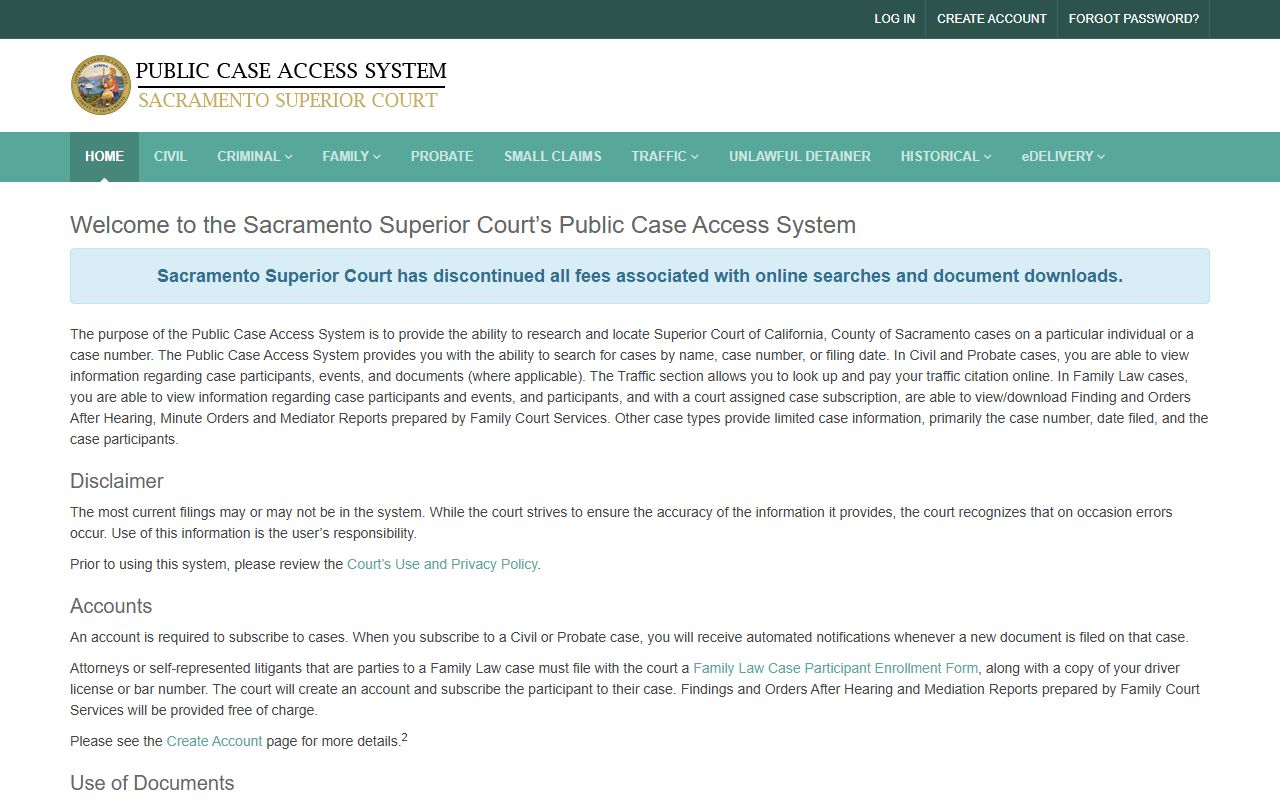
From the landing page, select Probate and choose case number or name search.
Guardianship of Minors in Sacramento County
A guardianship is a legal arrangement that gives an adult the authority to care for a child or to manage a minor's estate. The Sacramento Superior Court probate division hears guardianship petitions for minors. Common reasons include a parent's death, severe illness, deployment, or inability to care for the child. The court runs an investigation through court investigators and may require a background check, home visit, and notice to interested parties.
Guardianship files involving minors are partly public and partly confidential. The case caption, docket events, and orders may appear on the public portal. Investigator reports, medical records, school records, and other sensitive items can be limited to the parties and their attorneys. Welfare and Institutions Code section 827 protects related juvenile dependency files; private guardianship files in probate are not the same as juvenile dependency files but follow similar privacy rules.
Conservatorship of Adults
A conservatorship is for adults who cannot adequately provide for their own personal needs or manage their finances. Sacramento conservatorship cases run through the probate division. The court appoints a conservator of the person, a conservator of the estate, or both. Public Guardian conservatorships are filed by the Sacramento County Public Guardian when no private conservator is available. Limited conservatorships handle adults with developmental disabilities and use a more tailored set of orders.
Conservatorship files include capacity declarations from doctors, court investigator reports, accountings, and orders. Capacity material and medical reports are sensitive and usually restricted. The public docket may show that an evaluation was filed without exposing its content. LPS conservatorships under the Lanterman-Petris-Short Act handle severe mental illness and follow Welfare and Institutions Code section 5328 confidentiality.
Confidential Probate Information
Probate is more open than juvenile or family law but still has limits. Common redactions and restrictions include Social Security numbers, account numbers, minor names and dates of birth, victim identifiers, mental health and medical reports, conservatorship capacity records, and any record sealed by court order under California Rules of Court 2.550 and 2.551. Adoption files are confidential under Family Code section 9200 and are not available in routine probate search.
A user who needs a copy of a confidential record must usually be a party, an attorney for a party, or someone with a court order authorizing access. The clerk will require ID and may require a sworn statement. A request for a sealed record requires a motion to unseal under the California Rules of Court.
Estate Administration Timeline
Probate is slow by design. The shortest realistic timeline for an uncontested estate is several months. The statutory creditor claim period runs four months from issuance of Letters in many cases. Notice, publication, inventory and appraisal by the probate referee, and accounting steps each take time. A simple, uncontested estate often takes nine to eighteen months from filing to final distribution. A contested estate can run years.
Real estate sales add steps. The personal representative may need court confirmation for some sales, depending on the authority granted under the Independent Administration of Estates Act. Multi-state assets can require ancillary probate in other states. Tax issues, especially federal estate tax filings, can delay the final distribution. Patience is a real requirement in any Sacramento probate case.
Small Estate Alternatives Under California Law
Not every California estate needs a full probate. State law allows small estate procedures that move assets to heirs without opening a full court case. The Probate Code sets a dollar threshold that changes over time. When the estate is at or below the limit, an heir can use a Small Estate Affidavit to claim personal property such as bank accounts. Real estate transfers under a higher threshold use a different streamlined process, the Petition to Determine Succession to Real Property.
These shortcuts skip many of the steps in a full probate, including Letters, creditor publication, and final accounting. They are not available when there is a will contest, complex creditor claims, or assets above the threshold. The court self-help center is the best place to confirm whether a small estate option applies to a particular case.
Sacramento Probate Glossary
Probate uses old words that confuse most first-time filers. A short glossary helps when reading the docket or the will.
- Testator
- A person who has made a will. A female testator is sometimes called a testatrix in older documents.
- Executor
- The person named in a will to handle the estate. The court issues Letters Testamentary to the executor.
- Intestate
- Dying without a valid will. The state's intestate succession rules then decide who inherits.
- Decedent
- The deceased person whose estate is being administered.
- Conservatee
- The adult who is under a conservatorship.
- Ward
- The minor who is under a guardianship.
- Letters Testamentary
- The court order that gives an executor authority to act for the estate.
- Letters of Administration
- The court order that gives an administrator authority when there is no will or no executor.