
How to Search Sacramento County Court Records
The Sacramento Superior Court runs its public search at services.saccourt.ca.gov/PublicCaseAccess. The portal is free. It covers civil, criminal, family, probate, small claims, and traffic cases. A search begins with a case type. Then you pick case number or party name. Case number is the cleaner search because names get misspelled, abbreviated, or changed. If you do not have a case number, last name plus first name and a filing-date range will get you close on most case types.
Before you start, jot down what you know. The full legal name, prior names, and an approximate filing year all help. The criminal tab may ask for a date of birth to cut down on common-name hits. Keep the case number once you find it. You will need it for any later copy request at the Clerk of the Superior Court.
- Open the Public Case Access landing page at services.saccourt.ca.gov/PublicCaseAccess.
- Choose the case type: civil, criminal, family, probate, small claims, or traffic.
- Pick case-number search or name search on the tab or radio control.
- Enter the case number, or the last name first and the first name after a broad result list.
- Narrow by filing-date range or, on the criminal tab, by date of birth where the form asks for it.
- Review the result row for court, case number, parties, filing date, case type, and status.
- Click the case number link to see the docket, hearings, parties, and viewable filings.
The criminal portal at services.saccourt.ca.gov/PublicCaseAccess/Criminal uses the same field set with one extra field for date of birth.
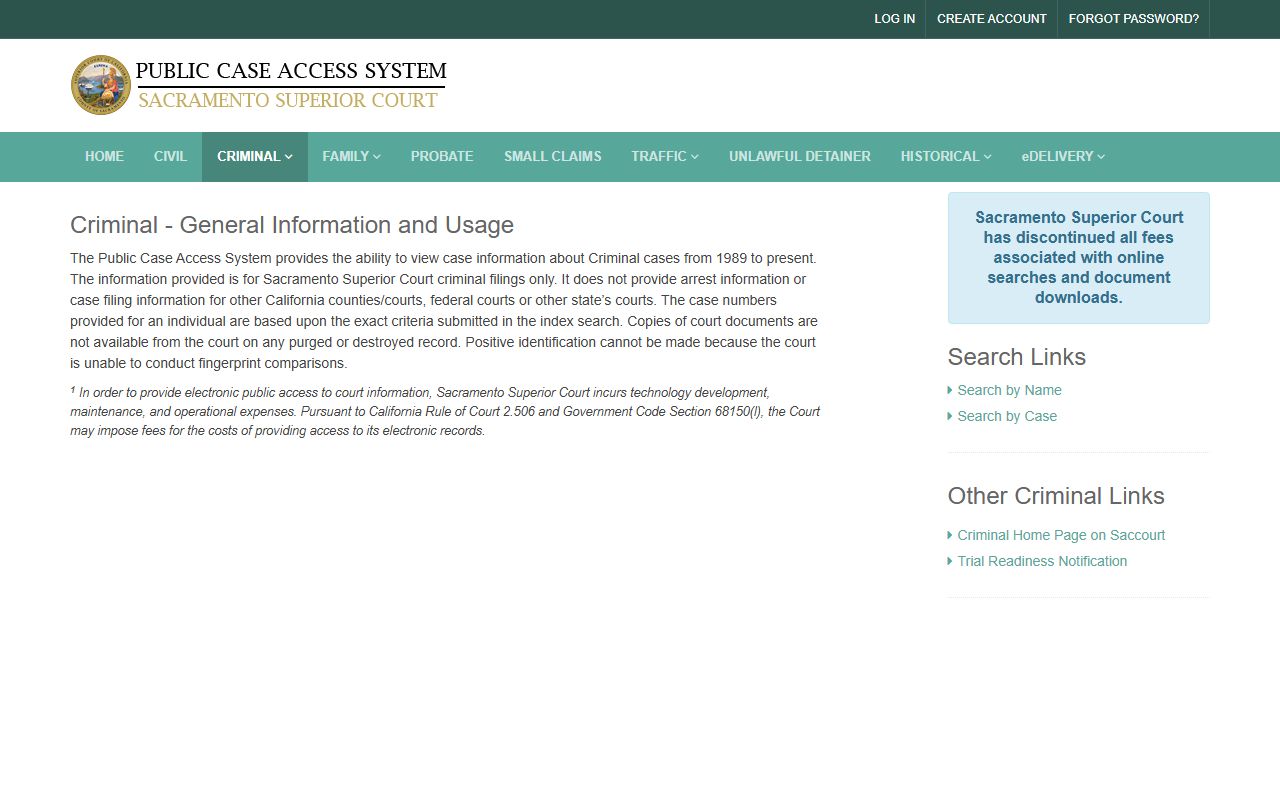
The criminal tab adds a date-of-birth field for defendant searches.
Sacramento County Court Records Search Fields
The Public Case Access portal uses a short list of fields. Most tabs share the same set. The criminal tab adds a date-of-birth control. The table below lists the common public fields drawn from Sacramento Superior Court.
| Field Label | Type | Required | Notes / Format |
|---|---|---|---|
| Case Number | Text | No | Format depends on case type and year. Best field when known. |
| Last Name / Business Name | Text | Conditional | Used for party search. Use exact spelling. |
| First Name | Text | No | Narrows person search results. |
| Date of Birth | Date | Sometimes | Used on criminal searches to cut false matches. |
| Filing Date From / To | Date range | No | Narrow by filed date. |
| Case Type | Dropdown | No | Civil, family, probate, small claims, criminal, traffic. |
| Search | Button | n/a | Runs the query. |
The family-law portal at services.saccourt.ca.gov/PublicCaseAccess/Family uses the same form for divorce, custody, parentage, and support cases. Public docket entries are searchable, but many of the underlying documents in family files are restricted.
The Sacramento County Judicial System
California's court system has three main levels: the Supreme Court of California, the California Courts of Appeal, and the Superior Courts. Sacramento County is served by the Superior Court of California, County of Sacramento. Unlike states that split trial work among district courts, county courts, justice courts, and municipal courts, California uses one unified Superior Court in each county. In 1998, California voters approved trial court unification. Sacramento's old municipal courts merged into the Superior Court. Today the Sacramento Superior Court hears criminal, civil, family, probate, juvenile, traffic, small claims, and unlawful detainer cases. Appeals from Sacramento Superior Court go to the California Court of Appeal, Third Appellate District. Further review may go to the Supreme Court of California.
People from other states often search for "Sacramento County district court." California does not use that term for state-law cases. The local trial court is the Superior Court. "District Court" in Sacramento usually means the U.S. District Court for the Eastern District of California, a federal court with its own judges, case numbers, fees, and PACER access.
Case flow: Sacramento Superior Court › California Court of Appeal, Third District › Supreme Court of California.
| Court | Jurisdiction | Case Types |
|---|---|---|
| Sacramento Superior Court | Sacramento County trial court | Criminal, civil, family, probate, juvenile, traffic, small claims. |
| Court of Appeal, Third Appellate District | Northern California appellate | Most civil and felony criminal appeals from Sacramento County. |
| Supreme Court of California | Statewide high court | Discretionary review; mandatory review for death penalty cases. |
| U.S. District Court, Eastern District of California | Federal trial court | Federal criminal and civil cases. Searched on PACER. |
Sacramento Superior Court works through divisions, not separate sovereign courts. A felony, a divorce, a probate estate, and a small claims case are all filed at the Sacramento Superior Court. They sit in different divisions and sometimes different buildings, but they share one court system. That structure is why the Public Case Access portal can sort cases by tab while still being run by one court.
Sacramento Superior Court vs U.S. District Court
Sacramento has both a state Superior Court and a federal U.S. District Court. The two run on separate tracks. The comparison below maps the main features.
| Feature | Sacramento Superior Court | U.S. District Court, Eastern District of California |
|---|---|---|
| Court system | California state trial court | Federal trial court |
| Cases heard | State criminal, civil, family, probate, juvenile, traffic, small claims | Federal crimes, federal civil cases, federal-question and diversity matters |
| Search portal | Public Case Access (free) | PACER (fees apply) |
| Main courthouse | Gordon D. Schaber, 720 9th Street | Robert T. Matsui United States Courthouse |
| Appeals | California Court of Appeal, Third District | U.S. Court of Appeals for the Ninth Circuit |
| Prosecutor | Sacramento County District Attorney Thien Ho | U.S. Attorney's Office, Eastern District of California |
For federal court records, use the Eastern District CM/ECF system at ecf.caed.uscourts.gov and PACER. The federal court does not show up in Sacramento Superior Court's portal.
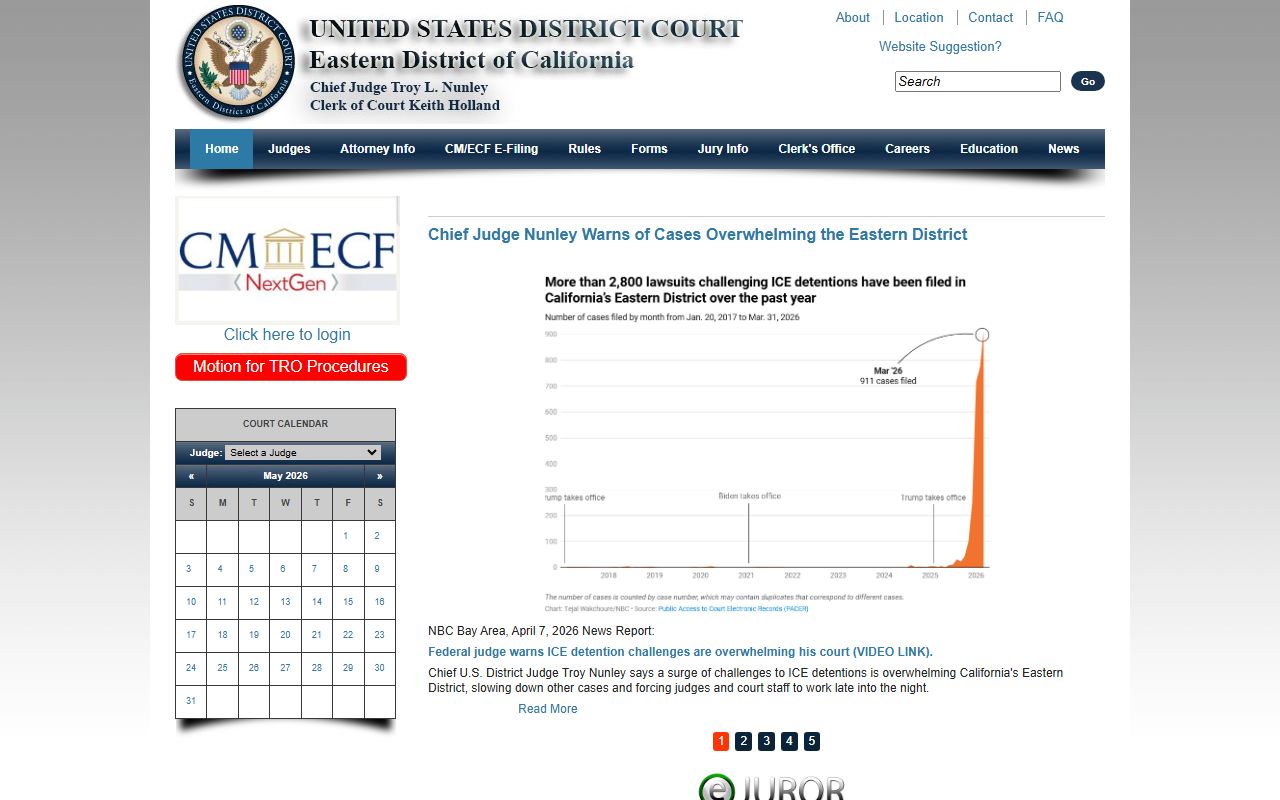
Federal cases out of Sacramento County are filed in the Eastern District of California, not at Sacramento Superior Court.
Sacramento County Courthouses
Sacramento Superior Court operates several courthouses across the county. The main building is the Gordon D. Schaber Sacramento County Courthouse downtown, named for the longtime dean of McGeorge School of Law. Family law sits at the William R. Ridgeway Family Relations Courthouse on Power Inn Road. Traffic and high-volume calendars sit at the Carol Miller Justice Center. Juvenile matters are at the Juvenile Courthouse on Kiefer Boulevard. Each address is below.
William R. Ridgeway Family Relations Courthouse
3341 Power Inn Road
Sacramento, CA 95826
Each courthouse has security screening at the public entry. Weapons are not allowed. Phones are usually allowed in the building, but recording in a courtroom requires court rule and judicial permission. Confirm the building before you go. A criminal hearing at the Schaber courthouse and a custody hearing at Ridgeway are two different trips.
Types of Court Records Available in Sacramento County
Sacramento Superior Court files cover the full range of state trial-court work. Records sit by division. Civil, criminal, family, probate, traffic, small claims, juvenile, and mental health each have their own intake, hearing schedule, and access rules. Most adult civil and criminal docket entries are public. Family files have public dockets and restricted documents. Juvenile and adoption files are confidential.
The categories below cover the main record types.
- Criminal records. Felony and misdemeanor cases. Includes complaints, plea forms, warrants, sentencing minutes, and probation orders. See criminal records.
- Civil records. Lawsuits over contracts, injury, debt, employment, and property. Includes complaints, motions, judgments, and writs.
- Family law records. Divorce, custody, support, parentage, and domestic violence restraining orders. See marriage and divorce records.
- Probate records. Estates, wills, guardianships, conservatorships, and trusts. See probate records.
- Traffic records. Citations, payment, traffic school, failure to appear, and trial by declaration.
- Small claims records. Low-dollar civil disputes for self-represented parties.
- Juvenile records. Delinquency and dependency. Confidential under state law.
What Sacramento County Court Records Show
A Sacramento court record is built case by case. The docket lists each filing and event. A case detail page shows the parties, the attorneys, the hearing schedule, and the case status. Some filings have viewable images. Others are listed only as docket entries. The chart below maps the common fields you will see in Public Case Access.
| Field | What It Shows |
|---|---|
| Case Number | Unique court identifier. Format varies by division and year. |
| Filing Date | The date the court opened the case. |
| Parties | Plaintiff, defendant, petitioner, respondent, decedent, conservator, guardian. |
| Charges / Cause | Charge description and code section in criminal cases. Cause of action in civil cases. |
| Disposition | The current or final outcome: dismissed, judgment entered, sentenced, closed. |
| Sentence / Judgment | Probation, fines, custody time, civil judgment amount, family orders. |
A public detail page does not always mean a downloadable image. A docket entry can show the filing date and the title while the document itself sits offline. To get the paper, file a copy request with the Clerk of the Superior Court.
Public Access Laws for Sacramento County Court Records
California splits access law between agency records and court records. County agencies like the Sheriff and Clerk/Recorder fall under the California Public Records Act, now at Government Code section 7920.000 and the sections that follow. Court case files follow court rules and specific confidentiality statutes. The list below covers the main authorities.
Key Statutes:
California Public Records Act, Gov. Code § 7920.000 — Opens most state and local agency records unless an exemption applies.
California Rules of Court, Rule 2.400 — Public access framework for trial court records.
California Rules of Court, Rule 2.550 — Sets the standard for sealing a court record; requires overriding interest and narrow tailoring.
Welf. & Inst. Code § 827 — Juvenile case files are confidential.
Gov. Code § 68150 — Sets trial court record retention and destruction authority.
Public access does not mean free, instant, or complete. A record can be public and still need a copy fee, ID, certification, or an in-person visit. A docket entry can be public while the underlying image is offline. A case can be searchable by case number and yet hold redactions on the party names. The court can keep older paper in archive storage that takes time to pull.
Records That Are Restricted or Confidential
Several categories of Sacramento court records are closed by state law. Juvenile delinquency and dependency files sit under Welfare and Institutions Code section 827. Juvenile records may also be sealed under Welfare and Institutions Code section 781. Adoption records are closed under Family Code section 9200. Mental health treatment records are confidential under Welfare and Institutions Code section 5328. Adult arrest records can be sealed under Penal Code section 851.91 when no conviction follows. Postconviction dismissal under Penal Code section 1203.4 changes how a conviction appears but does not wipe every record.
To view a sealed file, a petitioner usually files a motion with the court that handled the case. Notice may need to go to the prosecutor or to other agencies. A judge decides. Common reasons for denial include ineligible offense type, pending charges, missing proof of sentence completion, statutory exclusions, or filing in the wrong court. Even with relief, some agencies and licensing boards still see the record under statutory exceptions.
Specialty Courts in Sacramento County
Sacramento Superior Court runs collaborative courts that combine judicial oversight with treatment, case management, and accountability. The court's collaborative courts page lists current programs. Eligibility depends on charge type, criminal history, clinical assessment, public safety review, and willingness to take part. The main programs are below.
- Drug / treatment court. For defendants whose criminal behavior is tied to substance use. Court reviews, treatment attendance, drug testing, and graduation requirements.
- Mental health court. Assessment, treatment planning, supervised release, medication compliance, and review hearings.
- Veterans treatment court. Justice-involved veterans with service-related trauma, substance use, or mental health needs. Includes VA coordination and mentorship.
- Reentry court. For people returning from custody. Connects probation, treatment, housing, employment, and court reviews.
Treatment details remain confidential even when the underlying criminal docket stays public. A collaborative court file can hold case minutes, progress notes, and clinical reports that are not open to the public.
Sacramento County Sheriff and Jail
The Sacramento County Sheriff's Office runs the county jail system. Sheriff Jim Cooper is the elected Sheriff. The Sheriff is separate from the court. The Sheriff books people into jail, runs custody, sets visitation rules, and processes release. The court sets bail, hears charges, issues warrants, and enters judgments. The two systems share data but answer different questions. The Sheriff's site is at sacsheriff.com.
The Main Jail at 651 I Street sits a short walk from the Schaber courthouse downtown. It handles intake and houses many newly booked people and court-transport population. The Rio Cosumnes Correctional Center, in Elk Grove at 12500 Bruceville Road, houses additional pretrial and sentenced inmates. The Sheriff's inmate search at sacsheriff.com/InmateInformation/SearchNames.aspx shows current custody data by name. For full custody detail and visitation, see Sacramento County inmate records. For active warrant questions, see warrant records.
The Sheriff's inmate information page is the gateway to name search, facility info, and inmate services.
Note: A booking photo may be withheld for some non-violent charges under California law; the missing mugshot does not mean no arrest.
Marriage, Divorce, and Probate Records
Marriage and divorce sit in different offices. Marriage licenses and certified copies of marriage records come from the Sacramento County Clerk/Recorder, run by Florence Evans. The official site is ccr.saccounty.gov. Divorce filings, custody orders, support orders, and family law dockets are kept by Sacramento Superior Court at the Ridgeway courthouse. Probate matters, including estates and conservatorships, are also Superior Court work. Use marriage and divorce records for the full process and probate records for estate and conservatorship search.
- Testator
- A person who makes a will.
- Executor
- A person named in a will to administer the estate after death.
- Conservator
- A person appointed by the court to manage an adult who cannot care for personal needs or finances.
Sacramento County Court Records Fees
Sacramento Superior Court charges fees for copies, certification, and exemplification. The amounts come from statewide and local fee schedules. Plain copies are cheapest. Certified copies cost more. Exemplified copies, also called triple-seal or authenticated copies, cost the most and are used for out-of-state matters. The table below lists the common fee items. Check the official court forms page for the latest dollar amount before you order.
| Item | Source |
|---|---|
| Plain copy per page | Sacramento Superior Court fee schedule |
| Certified copy per page | Sacramento Superior Court fee schedule |
| Certification fee | Sacramento Superior Court fee schedule |
| Exemplified copy | Sacramento Superior Court fee schedule |
| Marriage license | Sacramento County Clerk/Recorder fee schedule |
| Marriage certificate copy | Sacramento County Clerk/Recorder fee schedule |
Court filing fees and copy fees come from the Superior Court. Marriage licenses, recorded document copies, and vital record fees come from the Clerk/Recorder. A user who asks the Clerk/Recorder for a divorce judgment will be sent to the Superior Court family division.
How to Interpret Sacramento County Court Records
Court records use short codes and standard abbreviations. A docket may list "FTA" for failure to appear, "BW" for bench warrant, "ROA" for register of actions, "CMC" for case management conference, or "OSC" for order to show cause. A criminal disposition can show "PG" for plea of guilty, "NC" for no contest, or "DISM" for dismissal. The Sacramento civil division also posts document processing dates each Friday. If your filing does not yet show, compare the submission date with the posted processing date before assuming the document was rejected.
Charges and convictions are not the same. An arrest can happen without a filed case. A filed charge can be dismissed. A conviction is a court finding of guilt entered after plea or trial. The Sacramento Public Case Access portal shows charges and dispositions, but it does not replace the official California Department of Justice criminal history record. The DOJ holds the full rap sheet and limits who can see it under criminal history dissemination rules.
Accuracy, Updates, and Record Limitations
Online court records can lag behind the courtroom. Minute orders may take days to post. Civil filings can sit in a processing queue before they appear on the public docket. The Sacramento civil division updates posted processing dates every business Friday by 5:00 p.m. Jail records can lag too. A newly booked person may not show on the Sheriff's search until intake finishes. A released person may stay on the search for a short window before the record drops.
If a record looks wrong, contact the office that holds it. Court errors go to the court clerk that processed the filing. Jail data errors go to the Sheriff. Vital records errors go to the Clerk/Recorder. Do not rely on the online copy alone for a legal deadline. Verify with the office that owns the file.
Note: Verify a court date, custody status, or warrant directly with the court or Sheriff before relying on an online entry for a legal decision.
History of Sacramento County Courts
Sacramento is one of California's original counties. The city of Sacramento became the state capital in 1854 and a major Gold Rush-era commercial and government center. The local court system started as a mix of county and municipal courts. In 1998, California voters approved trial court unification. Sacramento's municipal courts merged into the Superior Court. The Gordon D. Schaber Sacramento County Courthouse downtown is named for the longtime dean of McGeorge School of Law. Sacramento also hosts the Court of Appeal, Third Appellate District, and the U.S. District Court for the Eastern District of California. That pairing makes downtown Sacramento home to state trial court, state appellate court, and federal court within a short walk.
Self-Help and Legal Aid in Sacramento County
The Sacramento Superior Court self-help center is at saccourt.ca.gov/self-help. It covers family law, civil harassment, restraining orders, small claims, probate, and other topics for people without lawyers. The California Courts Self-Help Guide at selfhelp.courts.ca.gov gives statewide guidance. The Judicial Council forms library at courts.ca.gov/forms has every standard form.
The Sacramento County Public Defender, at pubdef.saccounty.gov, represents people who qualify for appointed counsel in criminal cases. The DA's victim services unit, at sacda.org/victim-services, helps crime victims with rights, restitution, and notifications. Legal Services of Northern California serves low-income clients in Sacramento on housing, public benefits, and domestic violence civil matters. The State Bar of California at calbar.ca.gov runs a lawyer search and a referral system.
The statewide self-help guide is a free starting point for self-represented parties.
Frequently Asked Questions
The questions below pull from the most common Sacramento Superior Court search topics. For more, see the full Sacramento County Court Records FAQ.
How do I search Sacramento County court records?
Use the Sacramento Superior Court Public Case Access portal at services.saccourt.ca.gov/PublicCaseAccess. Pick the case type. Search by case number when you have it. Use last name and first name if you do not. Some files are sealed and will not show. Other files exist only as paper in the clerk's archive. The portal is free.
Are juvenile records public in Sacramento?
No. Welfare and Institutions Code section 827 makes juvenile case files confidential. Access is limited to people listed in the statute and to those allowed by court order. The portal will not show juvenile records. A person with a legal need for a juvenile file usually needs an order from the judge who handled the case.
How do I get a certified copy of a Sacramento court record?
Ask the Sacramento Superior Court Clerk's Office at the right courthouse for the copy form, then pay the fee. A certified copy carries a court seal stating the copy matches the official file. Plain photocopies and screenshots are not certified. See the Clerk of the Superior Court page.
More on the Sacramento County Court Records FAQ page.